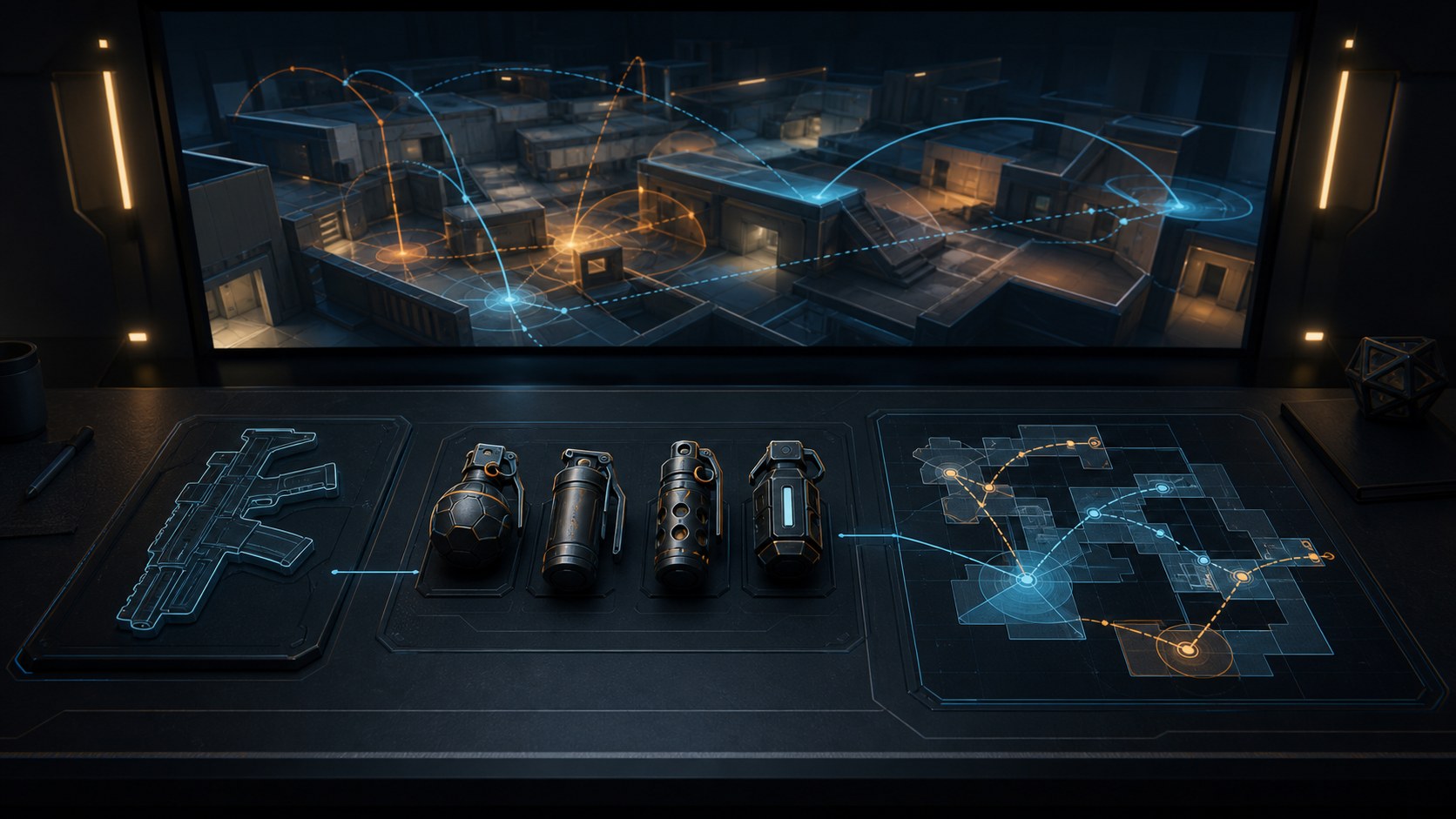
Counter-Strike 2 does not have talent trees, armor sets, or character builds. Yet every serious round still asks a build question: what weapon should I carry, which four grenade slots solve this round, and what job will I perform with them? In CS2, a build is not a permanent character sheet. It is a temporary tactical package assembled from money, equipment, spawn, map position, teammates, and the opponent’s habits.
This long-form CS2 loadout guide turns that idea into a practical system. You will learn weapon packages, utility configurations, role-based playstyles, buy-round templates, anti-eco adjustments, and a simple process for creating your own “build” without copying professional executes you cannot coordinate.
The CS2 build formula: choose one weapon that fits the expected distance, buy enough armor to make that weapon reliable, reserve money for the utility your job requires, and enter the round with one clear first action plus one fallback. A rifle with no plan is not a build; a cheaper gun, a smoke, two flashes, and a coordinated timing can be.
What “Build” Means in Counter-Strike 2
A useful CS2 build has three layers:
- Weapon layer: primary gun, pistol, armor, and kit decisions that determine how you can take fights.
- Utility layer: smoke, flashbang, HE, Molotov or incendiary choices that create, deny, delay, or punish space.
- Playstyle layer: entry, support, trade, lurk, anchor, rotate, or AWP responsibilities that turn equipment into round impact.
The layers must agree. An entry rifler who spends everything on a rifle and carries no flash may need a teammate to enable the first duel. A support player who buys two flashes but runs through the doorway first is wasting the strength of the package. An AWP build without a safe opening angle, escape route, or close-range teammate is only an expensive gun.
Builds also change during the match. Counter-Strike is an economy game: a setup that is correct at $7,000 may be irresponsible at $3,800. Read our complete CS2 economy guide if eco, force buy, full buy, and save decisions are not yet automatic.
The Five Questions to Ask During Freeze Time
- What can the whole team afford? Your personal money is not the team economy.
- What distance will I probably fight at? Long rifle lane, close choke, mobile rotation, or scoped opening?
- What utility must survive until later? A smoke for the execute, a Molotov for the plant, or an incendiary for the final rush?
- Who throws the first flash? If nobody owns the task, the team will dry peek.
- What is my fallback? If the opening pick fails, where do you retreat, regroup, or trade?
Answering these questions produces better buys than memorizing one “best loadout.” The correct build is contextual and team-dependent.
Core Rifle Build: The Default Full-Buy Package
| Side | Primary | Armor | Utility priority | Job |
|---|---|---|---|---|
| T | AK-47 | Kevlar + helmet when appropriate | Smoke, 2 flashes, Molotov | Take space, trade, execute |
| CT | M4A1-S or M4A4 | Kevlar; helmet depends on enemy buy | Smoke, flash, incendiary, HE | Hold, delay, survive, rotate |
The AK-47 is the standard Terrorist rifle because its armored headshot potential changes every duel. The M4A1-S rewards controlled bursts and low-signature holds, while the M4A4’s larger magazine gives anchors more tolerance against several attackers. Both M4s currently cost $2,900, so the decision is about position and firing pattern rather than price.
Rifle technique: stop before the first bullet
The most important rifle “perk” is counter-strafing. Release the movement key and briefly tap the opposite direction so horizontal velocity reaches an accurate state before firing. Beginners often blame recoil for bullets that were inaccurate before recoil even became relevant.
At long range, use taps or short bursts. At medium range, controlled bursts and disciplined resets dominate. Commit to a spray only when the distance, target count, and cover justify it. If you need detailed price, damage, and use-case comparisons, open the CS2 weapons guide.
The 2026 reload rule changes the build
Valve redesigned reloading in March 2026: reloading now discards the used magazine and any ammunition remaining inside it, then consumes a fresh reserve magazine. That makes nervous one-bullet reloads strategically expensive. A weapon package is no longer only about magazine capacity; it is also about reserve discipline.
Reload behind hard cover, after counting nearby threats, and only when the remaining magazine cannot safely complete the next likely duel. M4A1-S users, smoke spammers, and players holding multi-enemy rushes must be especially deliberate.
Entry Build: Create Contact and Be Tradable
| Component | Preferred choice | Reason |
|---|---|---|
| Primary | AK-47; MAC-10 on anti-eco or limited buy | Immediate duel power or high mobility |
| Utility | Molotov + smoke; teammate carries first flashes | Clear one position and cut one sightline |
| Movement | Decisive path with minimal hesitation | Keeps the second player close enough to trade |
| Fallback | Call the defender’s position before death | Turns contact into usable information |
The entry’s job is not to collect a beautiful opening kill every round. It is to force the defense to reveal itself while remaining close enough to the team that a death can be traded. A good entry build therefore values mobility, a single space-clearing grenade, and synchronized teammate flashes.
Do not carry every critical smoke as the first body through a choke. If you die with the execute utility, the build has failed structurally. Transfer at least one late-round smoke to a support or second player.
Entry technique: isolate the first duel
Use smoke or Molotov geometry to reduce the number of defenders who can see you at once. Clear in a fixed order, keep the crosshair at head level, and avoid swinging so wide that the trading teammate cannot see the opponent. Speed without trade spacing is solo queue gambling.
Support Build: Turn Grenades Into Teammate Advantage
The support build is one of the highest-value packages in coordinated CS2 because flashbangs are inexpensive compared with rifles and can remove the defender’s ability to fight. Liquipedia lists the flashbang at $200, and its effect depends on the target’s view and orientation. A well-timed pop flash gives almost no warning; a slow visible flash simply asks the defender to turn away.
| Utility slot | Typical support choice | Purpose |
|---|---|---|
| 1 | Smoke | Remove a long sightline or isolate a site |
| 2 | Flashbang | Enable first contact |
| 3 | Flashbang | Reflash after defenders turn or reposition |
| 4 | Molotov / incendiary | Clear or delay a fixed position |
Support technique: throw for a specific teammate
“Flashing now” is incomplete. Call the target and timing: “flash above ramp for your swing in three.” The support watches the teammate’s approach, releases the flash so it detonates as the peeker becomes visible, then immediately prepares to trade or throw the second layer.
A support player should learn a small reliable set of throws before collecting dozens of lineups:
- one safe smoke for each main site entrance;
- one pop flash for the team’s most common opening fight;
- one retake flash on each bombsite;
- one Molotov for a common anchor or plant position;
- one emergency extinguishing smoke for fire.
Utility knowledge is strongest when attached to a repeatable team action.
Lurker Build: Information, Timing, and Route Control
A lurker is not a player who refuses to join the team. The lurker holds rotations, punishes pushes, preserves map uncertainty, and arrives when the defense has committed attention elsewhere.
Recommended package
- Primary: AK-47 or Galil when economy demands it.
- Utility: smoke plus Molotov, with one flash if the late route needs a self-pop.
- Equipment priority: reliable rifle and armor before buying an ornamental pistol upgrade.
- Information plan: know which sound cue or teammate contact triggers the move.
The lurker often needs utility later than everyone else. Preserve a smoke to cross a dangerous lane, create a fake, or cut the retake. Preserve a Molotov to remove a predictable post-plant defender. Throwing everything in the first twenty seconds destroys the build’s late-round value.
Lurk technique: manage sound and timing
Walk when silence protects uncertainty, but do not remain silent after the round has already revealed your route. Timing matters more than stealth as an identity. If the execute begins and you are still too far away to punish the rotate, you are not lurking—you are absent.
CT Anchor Build: Delay Without Donating a Kill
An anchor’s strongest resource is time. The build should let one player slow several attackers, survive long enough for rotations, and keep at least one piece of utility for the final commitment.
| Component | Anchor choice | Use |
|---|---|---|
| Primary | M4A4 for capacity or M4A1-S for controlled holds | Match the expected number and distance of fights |
| Smoke | Choke denial | Force attackers to wait, spam, or emerge disadvantaged |
| Incendiary | Rush delay | Break early timing and separate waves |
| HE | Stacked choke damage | Punish slowed players or a teammate’s contact |
| Flash | Self-pop or teammate reflash | Retake space without dry swinging |
Liquipedia notes that a smoke can extinguish incendiary fire. That interaction gives both sides a counter-build: the anchor delays with fire; the attackers spend a smoke to preserve tempo. In CS2, smoke is also volumetric and responsive. Valve’s official CS2 overview explains that bullets and HE explosions can temporarily clear visibility through smoke, creating brief tactical windows.
Anchor technique: stagger utility
Do not throw smoke, incendiary, HE, and flash simultaneously unless the round demands an emergency stop. One grenade every few seconds can deny more total time. First gather evidence, then spend the minimum resource that answers it. A footstep is not always a five-player execute.
AWP Build: Team Investment, Not Personal Luxury
Turn that team investment into reliable impact with our CS2 AWP guide, covering controlled peeks, angle holds, center-mass pre-aim, repositioning, utility support, and accuracy training.
The AWP costs $4,750 before armor and utility, so it reshapes the team’s entire buy. The build needs a planned opening angle, a close-range protector or escape route, and clarity about who recovers the weapon if the AWPer dies.
AWP package
- Primary: AWP.
- Pistol: keep the default or use an affordable sidearm only when team economy is healthy.
- Utility: smoke for escape or isolation; flash for repeek; incendiary/Molotov only when the position requires it.
- Movement: take one decisive shot, then reposition unless the opponent is forced into the same line.
AWP technique begins before the scope: pre-aim the expected height, reduce unnecessary exposure, and avoid crouching in a location with no escape. The objective is not to prove you can flick; it is to make the opponent enter a prepared line.
Force-Buy Build: Compress the Plan
A force buy cannot imitate a full buy with worse guns and no utility. It must create a short, high-variance situation that hides the equipment disadvantage.
T-side force template
- Galil, MAC-10, Tec-9, or upgraded pistols according to money.
- Armor on players expected to take contact.
- At least one smoke and two team flashes before luxury pistols.
- A fast group action that produces trades.
CT-side force template
- MP9, FAMAS, shotgun, or pistols matched to close positions.
- Stack or crossfire that prevents isolated long-range fights.
- Defuse kit only when the site plan gives a realistic retake chance.
- One delay grenade to force attackers into the chosen weapon range.
A force-buy build wins by geometry and timing. Put the MP9 in a close accelerating route, the shotgun behind a hard corner, and the pistols in a layered crossfire. Do not challenge an AK at its preferred range.
Anti-Eco Build: Protect the Expensive Weapons
Anti-eco rounds are lost when full-buy players search for solo kills in close corners where pistols and shotguns become dangerous. The correct build emphasizes distance, information, grouped trading, and utility that clears cheap-stack positions.
- Use SMGs when their mobility and kill rewards match the likely armor level.
- Keep rifles behind the first information layer rather than entering blind corners.
- Use HE grenades and Molotovs to punish stacks.
- Avoid donating the AWP to a close-range pistol.
- Finish the round with surviving weapons; economy damage matters.
Utility Builds: Four Packages for Common Jobs
| Build | Grenades | Best use | Main weakness |
|---|---|---|---|
| Execute support | Smoke, 2 flashes, Molotov | Structured site entry | Little direct damage |
| Solo space-maker | Smoke, flash, Molotov, HE | Flexible pug play | No second flash |
| CT delay anchor | Smoke, incendiary, HE, flash | Slowing a choke | Limited retake flashes |
| Retake specialist | Smoke, 2 flashes, HE | Defuse and site re-entry | Weak early fire denial |
Smoke: remove information and sightlines
A smoke is not a wall that permanently solves an angle. It is a timed information barrier. Opponents can push it, spam it, or use bullets and HE explosions to create temporary openings in CS2’s responsive volume. Always assign someone to watch the smoke edge.
Flashbang: buy a fraction of safe time
A flash works only when someone acts on it. Coordinate detonation with the peek, use geometry to reduce warning, and avoid blinding the teammate whose duel you are trying to help.
Molotov and incendiary: displace or delay
Fire is strongest against fixed positions and narrow paths. On attack, use it to force an anchor into the open. On defense, use it to separate the first attacker from the trade pack. Remember that smoke extinguishes fire.
HE grenade: finish damage or punish grouping
HE is more reliable after information. Combine it with a teammate’s contact, a slowing incendiary, or a narrow plant position. CS2’s responsive smoke also means an HE can briefly disturb smoke visibility, which may create a short information or firing window.
How to Build a Round Around Playstyle
Fast execute
Goal: arrive before the defense can layer utility. Carry two entry-enabling flashes, the minimum smokes needed to isolate key sightlines, and one Molotov for the anchor. The first player creates contact; the second trades; the support watches utility timing. The build fails if the team pauses in the choke after spending everything.
Slow default
Goal: collect information, punish aggression, and preserve options. Spread rifles into tradable pairs, retain at least two smokes for the final minute, and assign one player to watch each likely push. The build fails when players take isolated fights or use execute utility to answer harmless noise.
Contact play
Goal: approach quietly and explode only after reaching a favorable distance. Carry flashes for the moment contact is made, keep crosshairs on likely close defenders, and ensure the rear player watches the flank. The build fails when one early sound cue reveals everyone but the team continues pretending to be silent.
Fake and rotate
Goal: spend limited utility to represent commitment while keeping players and resources for the other site. The fake player needs believable timing, safe escape, and a smoke or flash that defenders recognize. The main group must not rotate so early that the defense hears or sees the truth.
A 30-Minute CS2 Build Practice Session
- Five minutes — buy menu: practice assembling full-buy, force-buy, and anti-eco packages without hesitation.
- Ten minutes — weapon mechanics: counter-strafe taps, three-to-five bullet bursts, one controlled spray, and reload discipline.
- Ten minutes — utility pair: learn one smoke plus one flash that combine into a real entry or retake.
- Five minutes — verbal script: say the plan aloud: first contact, grenade timing, trade path, and fallback.
Build practice should produce actions you can execute under pressure, not a library of clips you forget during a match.
Common Build Mistakes
Buying the strongest gun and zero utility
A rifle cannot simultaneously block an AWP angle, clear a corner, and flash a teammate. Spend according to the role, not the prestige of the weapon.
Giving every player the same grenade package
Five identical solo packages create duplicated utility and no timing ownership. Assign entry, support, late smoke, flank control, and retake resources.
Using utility without a follow-up
A smoke with no watched edge, a flash with no peek, or a Molotov thrown after the defender has left is only money disappearing. Every grenade needs an intended reaction.
Building for highlights rather than the round
An AWP on weak money, a Desert Eagle upgrade instead of a smoke, or an isolated lurk may produce a clip. A strong build increases the probability that all five players can complete the round.
Ignoring the opponent’s economy
Your anti-eco build should avoid close chaos; your anti-AWP build should deny long lines; your response to a weak CT buy should pressure their limited utility. Build against what the opponent can realistically own.
FAQ
Does CS2 have character builds?
No. Players share the same mechanical rules. A CS2 “build” is a round-specific combination of weapon, armor, utility, position, and tactical responsibility.
What is the best beginner CS2 build?
Use AK-47 on T side or M4A1-S on CT side, buy armor, and carry a smoke plus two flashbangs whenever the economy allows. Learn one useful smoke and one teammate flash on each main map before expanding.
How many grenades should a support player buy?
As many useful grenades as the team economy and plan support, normally filling the available slots on a full buy. Smoke, two flashes, and fire is a strong execute package; smoke, flash, HE, and incendiary is a flexible CT anchor package.
Should the entry player carry the execute smokes?
Usually not all of them. The first player is most likely to die early. Keep critical late or post-plant utility on the second, support, or lurk player.
What is the difference between a loadout and a round build?
The menu loadout determines which weapons are available to buy for each side. A round build is the actual weapon, armor, grenades, position, and job selected for the current situation.
Where should a new player start?
Begin with the CS2 beginner guide, then learn economy and weapons. Once the rules feel natural, use this build framework to connect buying decisions to team tactics.
Final Build Philosophy
The best CS2 build is not the most expensive inventory. It is the cheapest coherent answer to the round. Weapon range, utility purpose, teammate spacing, and fallback timing should all point in the same direction.
Build the team before the rifle: decide who creates contact, who flashes, who trades, who protects the late utility, and who watches the rotation. Then buy the tools that make those jobs possible. That is CS2’s real buildcraft—and it is deep enough to decide matches without a single talent point.
Continue through the Spack Night Counter-Strike 2 strategy hub for economy, weapons, sensitivity, performance, and beginner fundamentals.
Sources and Update Notes
- Valve: Guns, Guides, and Games — March 18, 2026 — official redesign of magazine and reserve-ammunition behavior.
- Valve: Counter-Strike 2 overview — official explanation of responsive smoke, bullet/HE interaction, and subtick grenade consistency.
- Valve: Show Off update — September 16, 2025 — official loadout inspection and grenade-audio changes.
- Liquipedia Counter-Strike Weapon Chart — cross-reference for weapon prices, capacity, and damage context.
- Liquipedia: Flashbang — price, viewing-direction effect, and pop-flash usage.
- Liquipedia: Incendiary Grenade — price, delay role, and smoke-extinguish interaction.
One thought on “CS2 Builds and Tactics Guide: Weapon Loadouts, Utility Kits, and Playstyles”