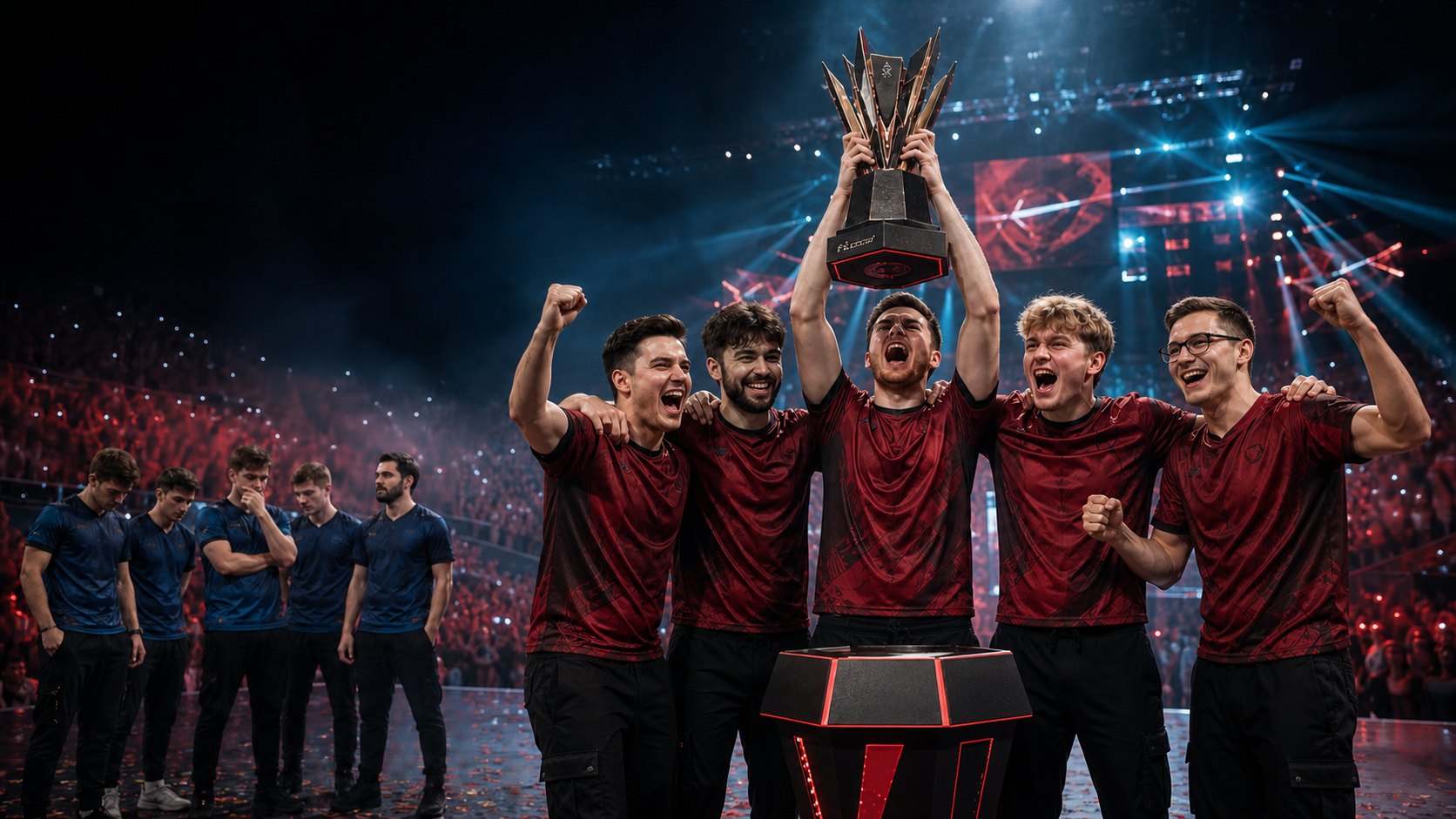
MOUZ did not beat Spirit by waiting for donk to have a bad day. They won the BLAST Bounty 2026 Season 2 final by building a match in which Spirit’s explosive stars repeatedly had to solve layered problems: traded entries, changing defensive looks, stable spacing and a red-hot Spinx who converted nearly every useful opportunity.
The 3-1 result in Malta ended MOUZ’s 17-month trophy drought and snapped a seven-match losing streak against Spirit. It also produced the first HLTV MVP award of Spinx’s career. For ordinary CS2 players, however, the most valuable part of the final was not the trophy or the rating. It was the structure behind the result.
This analysis breaks down what happened, why it mattered, and seven lessons you can apply in Premier, FACEIT or a regular five-stack without copying professional utility lineups pixel for pixel.
| Map | Spirit | MOUZ | What defined it |
|---|---|---|---|
| Dust2 | 8 | 13 | MOUZ established the pace and Spinx opened with a 1.91 rating |
| Mirage | 4 | 13 | Clear spacing and decisive conversions denied Spirit momentum |
| Ancient | 13 | 9 | Spirit recovered from 6-9 as donk returned to impact |
| Nuke | 10 | 13 | MOUZ stayed composed through a close second half and finished against a low buy |
Scores and player statistics in this article are based on HLTV’s match report and MVP coverage published August 2, 2026.
What Happened in the MOUZ vs Spirit Final?
MOUZ won Dust2 13-8 and crushed Mirage 13-4 to build a 2-0 series lead. Spirit responded on Ancient, turning a 6-9 deficit into a 13-9 victory, but MOUZ refused to let one lost map rewrite the match. Nuke reached 10-10 before MOUZ secured the final three rounds and closed the series 13-10.
The victory mattered for three reasons. First, Spirit had repeatedly controlled the matchup before this final. Second, this was MOUZ’s first event after bringing academy graduate PR into the lineup. Third, Spinx delivered the best grand final of his career: 78 kills, a 1.54 rating, 89.3 ADR and 81.9% KAST across four maps, according to HLTV’s final report.
Those numbers are spectacular, but they do not describe four maps of isolated hero plays. Spinx said after the match that MOUZ’s communication was clear, the energy was good and he used his opportunities smartly. That is the useful clue: elite impact often begins before the duel.
Lesson 1: Break a Rival’s Pattern, Not Just Its Aim
When one opponent keeps beating you, the natural response is to focus on mechanics: aim harder, react faster, win more opening duels. That approach treats every loss as an individual failure. MOUZ’s breakthrough suggests a more useful question: what repeatable decisions is the opponent expecting from us?
A dominant team builds confidence from recognition. If the same defender appears at the same timing, the same lurker waits for the same rotation, or the same retake arrives from the same route, the stronger team plays faster because it is solving a familiar puzzle.
How to apply this in your own matches
- After losing two rounds at one bombsite, change the order of contact instead of simply buying again.
- Use an early smoke once as cover for aggression and the next time as a fake.
- Move the first-contact defender while preserving the same crossfire.
- Delay a default by ten seconds if the opponent has started pre-rotating.
- Do not repeat a successful setup until the enemy has had a chance to adapt; bank it for a high-value round.
Variation is not randomness. Every change should preserve trade distance, map control and a retreat plan. The goal is to make the opponent spend time confirming information instead of acting on memory.
Lesson 2: Good Spacing Turns Individual Duels Into Team Duels

Players often describe a successful entry as the first player “winning the duel.” That is only one possible outcome. A well-built entry can succeed even when the first player dies because the second player receives an immediate, predictable trade.
Bad spacing has two common forms. Players are either too far apart, creating isolated one-versus-ones, or too close together, allowing one spray or grenade to punish multiple bodies. The useful distance is contextual: close enough to trade before the defender escapes, but separated enough to clear different elevations and avoid blocking movement.
A practical three-player entry rule
- First player: clears the nearest lethal angle and creates reliable contact information.
- Second player: follows the same threat line closely enough to trade, without staring at the first player’s model.
- Third player: protects the trade pair from the next angle, holds the anti-flash position, or carries the bomb through secured space.
This concept is more valuable than memorizing a professional execute. If your teammates understand who creates contact and who trades, even a basic smoke-and-flash entry becomes difficult to defend.
For a deeper look at role-based weapon and utility packages, use our CS2 builds and tactics guide.
Lesson 3: A Star Performs Better When the Team Reduces Unnecessary Decisions
Spinx topped the scoreboard on every map of the grand final. He began with a 1.91 rating on Dust2, followed with 1.86 on Mirage, remained useful during the Ancient loss and closed Nuke with 1.41. The temptation is to reduce that performance to aim. His own explanation was more revealing: he felt that he used his opportunities smartly.

A player produces more impact when the surrounding system answers several questions in advance:
- Which angle is already covered?
- Who throws the enabling flash?
- Where does the trade come from?
- What happens after the first kill?
- Who keeps the flank from invalidating the play?
When those answers are clear, the star can focus on timing, crosshair placement and the opponent in front of them. In ordinary matchmaking, you can reproduce a smaller version of this effect. Before a round begins, give your best-positioned rifler one clear job and organize two teammates around it. “Spinx, take this duel after my flash” is a plan. “Spinx, go kill” is hope.
Use your best player without making the team predictable
Do not send the same player through the same doorway every gun round. Let the star alternate between first contact, second-wave trading and a late-round off-angle. The opponent should know that the player is dangerous without knowing where the danger must appear.
Lesson 4: Clear Communication Is a Mechanical Advantage
Spinx specifically highlighted clear communication after the final. That sounds less exciting than a multi-kill, but communication changes the mechanical difficulty of every fight. A player who knows the number of opponents, the available utility and the likely rotation route needs fewer mouse movements and fewer guesses.
The five-part useful call
A strong call contains only the information that changes the next decision:
- Location: where the opponent is.
- Number: confirmed players, not imagined players.
- Direction: pushing, falling back or holding.
- Damage or equipment: tagged, AWP, bomb seen, kit dropped.
- Your action: fighting, hiding, rotating or waiting for utility.
“Two ramp, one tagged, bomb seen, I am falling site” gives teammates a complete decision. “They’re all here!” creates panic and often pulls a rotation too early.
Clear comms also protect energy during a long best-of-five. Emotional commentary consumes the same voice channel used for round-winning information. Give the fact, make the next call and discuss the mistake after the round.
Lesson 5: Losing One Map Should Not Reset the Series
Spirit’s Ancient recovery was dangerous because it changed the emotional direction of the match. MOUZ had been ahead 9-6, then lost seven straight rounds as Spirit closed 13-9. A less stable team carries that collapse into the next pistol round, tries to recover the lost map immediately and begins forcing low-percentage plays.
MOUZ treated Nuke as a new problem. They reached halftime ahead 7-5, survived Spirit tying the score, and remained composed at 10-10. This is a transferable competitive skill: separate information from emotion.
A 30-second reset between rounds or maps
- Name one tactical reason the previous sequence failed.
- Choose one correction, not five.
- Confirm the next buy and opening setup.
- Stop replaying the lost clutch once freeze time ends.
If the problem was poor anti-eco spacing, correct spacing. Do not also change positions, sensitivity, leadership and the entire map plan. Teams recover faster when the correction is small enough to execute immediately.
Lesson 6: Anti-Eco Rounds Need More Respect Than Highlight Rounds
The final round of Nuke came against a low buy, but that does not make it automatic. Pistols and close-range weapons become dangerous when the better-equipped team rushes narrow geometry, carries the bomb first or gives isolated weapons away.
MOUZ reached map point with a Spinx quad-kill against pistols and then finished the following low-buy round. The broader lesson is that economic advantage must be converted through distance, information and recoverable weapons.
Simple anti-eco checklist
- Keep rifles away from close corners until utility clears them.
- Do not send the bomb with the first contact player.
- Pair every rifle so a dropped weapon can be recovered.
- Use molotovs and HE grenades before entering stacked choke points.
- When the site is empty, plant safely instead of hunting exits.
Economic fundamentals decide far more ranked games than spectacular clutches. Our complete CS2 economy guide explains eco, force-buy, full-buy and save decisions in detail.
Lesson 7: One Tournament Win Is Evidence, Not a Guarantee
The fastest way to waste a breakthrough is to believe the problem has been permanently solved. Spinx was careful after the match: he said he did not want to get ahead of the team’s progress and emphasized staying humble. That caution matters because new lineups can benefit from surprise. Opponents have limited demos, uncertain role reads and less confidence about veto choices.
MOUZ’s next test is not whether this trophy was “real.” It is whether their structure remains strong once rivals study PR’s positions, target the team’s best maps and prepare specific anti-Spinx protocols.
The same principle applies to personal improvement. One excellent match does not prove that your new sensitivity, role or routine is perfect. Measure it across enough games to separate a genuine improvement from favorable opponents and temporary confidence.
What Spinx’s MVP Numbers Actually Tell Us
| Grand-final metric | Spinx result | Practical meaning |
|---|---|---|
| Kills | 78 | Sustained output across all four maps, not one explosive half |
| Rating | 1.54 | Elite overall performance against top opposition |
| ADR | 89.3 | Consistent damage that made trades and cleanups easier |
| KAST | 81.9% | High involvement through kills, assists, survival and trades |
| Round swing | +4.97% | Actions repeatedly improved MOUZ’s chance of winning rounds |
No single metric tells the entire story. Kills can arrive in lost rounds, ADR can include low-value damage, and survival can reflect either discipline or excessive passivity. Together, however, Spinx’s figures describe a player who dealt damage, stayed connected to trades and repeatedly affected round outcomes.
HLTV’s MVP announcement notes that he earned three Player of the Map awards in the final. His post-match interview also emphasized teammates and staff rather than presenting the performance as an isolated carry.
A Five-Round Practice Plan Inspired by MOUZ
You do not need professional analysts to practice the same principles. In your next five-stack session, dedicate five gun rounds to five constraints:
- Round one — trade rule: no player takes first contact without a named trading partner.
- Round two — variation rule: show the same early utility as round one, then finish at the opposite site.
- Round three — star setup: use one flash and one smoke to give your best rifler a single favorable duel.
- Round four — communication rule: every call uses location, number and action; no emotional commentary during live play.
- Round five — anti-eco discipline: keep the bomb second wave, clear close corners with utility and refuse unnecessary hunts.
After the five rounds, review only three questions: Were deaths tradable? Did utility create a clear decision? Did every player understand the next action? This produces more useful improvement than reviewing the scoreboard alone.
FAQ
Who won BLAST Bounty 2026 Season 2?
MOUZ defeated Spirit 3-1 in the grand final in Malta on August 2, 2026. They won Dust2, Mirage and Nuke, while Spirit won Ancient.
Who was the BLAST Bounty Season 2 Finals MVP?
Spinx received his first career HLTV MVP award after recording 78 kills and a 1.54 rating in the grand final.
Was MOUZ’s win only caused by donk underperforming?
Spirit’s stars had quieter periods, but reducing the result to one player’s form ignores MOUZ’s spacing, conversion discipline and Spinx’s sustained output. MOUZ also recovered after Spirit won Ancient and tied Nuke 10-10.
What is the biggest lesson for normal CS2 players?
Make every duel easier before it begins. Use trade spacing, clear calls, supporting utility and different looks from the same setup. Better structure produces more repeatable wins than hoping for five individual highlights.
Final Takeaway
MOUZ’s victory over Spirit was a headline because it ended a long trophy drought and reversed a painful matchup. It is useful to players because it demonstrates a quieter truth about Counter-Strike: the team that reduces uncertainty for itself and creates uncertainty for the opponent usually looks mechanically faster.
Spinx supplied the exceptional finish, but the system gave those finishes meaning. Trade together. Change patterns deliberately. Communicate only what changes the decision. Respect low buys. Reset after a bad map. Those principles will not turn a Premier stack into a professional roster overnight, but they will immediately make your rounds less random.
Newer players should start with our CS2 beginner guide. For the mechanical side of turning good positions into kills, continue with the CS2 AWP guide and sensitivity setup guide.
Sources
- HLTV — MOUZ subdue Spirit to win BLAST Bounty Season 2
- HLTV — Spinx earns career-first MVP at BLAST Bounty Season 2 Finals
- HLTV — Spinx post-final interview
- HLTV — BLAST Bounty Season 2 grand final live report
Published August 4, 2026. Match results and statistics reflect the cited event coverage available at publication time. Tactical interpretations are Spack Night’s editorial analysis.