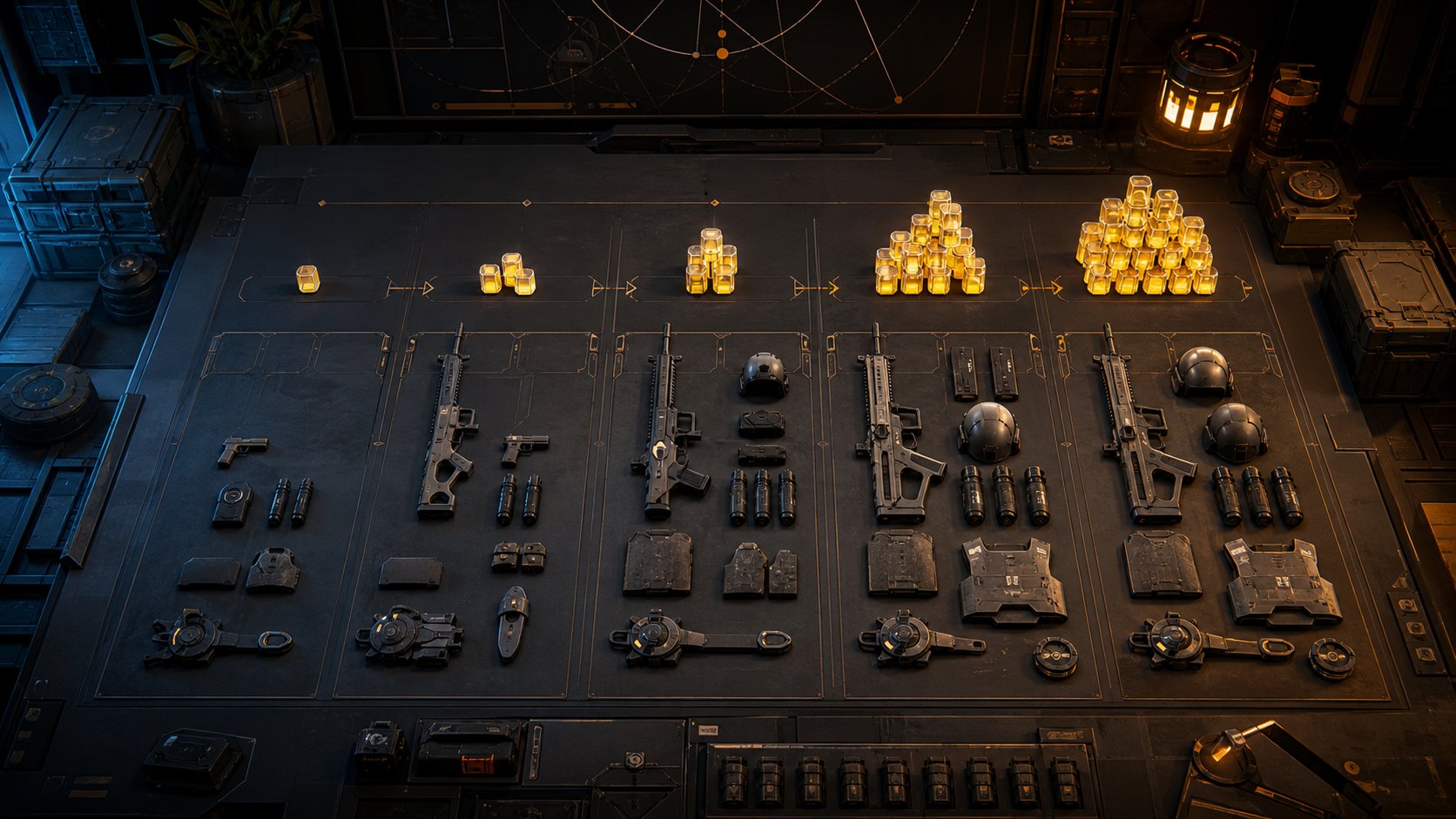
Economy values last checked: July 26, 2026. This guide covers the standard Competitive/Premier bomb-defusal economy. Community servers and special modes can use different settings, and Valve may rebalance prices or rewards in a future update.
Great Counter-Strike 2 players do not always have a perfect loadout. They are simply better at deciding which rounds deserve money, which rounds should be sacrificed, and which surviving weapon is worth more than a low-percentage final fight. Their advantage is not a secret source of cash. It is synchronization.
This CS2 economy guide explains Eco rounds, Half Buys, Force Buys, Full Buys, Bonus rounds, Anti-Ecos, drops, loss bonus, bomb money, kill rewards, and saving. More importantly, it shows how those pieces connect across several rounds. If the round rules are still unfamiliar, begin with our complete CS2 beginner guide. For exact gun prices and use cases, keep the CS2 weapons guide open beside this one.
The economy in one sentence
Do not ask, “What is the best gun I can buy?” Ask, “What is the strongest five-player round we can create now without destroying the next one?” A coordinated Eco followed by five complete rifles is usually stronger than two consecutive rounds of scattered pistols, weak armor, and one lonely rifle.
Quick Answer: Eco, Force Buy, Full Buy, and Save
| Call | What it means | What you buy | Why you do it |
|---|---|---|---|
| Full Eco | Spend almost nothing | Starter pistols; perhaps one planned cheap item | Guarantee a complete next buy |
| Light / Half Buy | Spend to a fixed limit | Pistols, armor, SMGs, or limited utility | Create upset potential while preserving next-round money |
| Force Buy | Spend most available money now | Best coordinated weapons, armor, and utility the team can afford | The current round matters enough to accept future risk |
| Full Buy | All five can execute a complete plan | Rifles/AWP, armor, role-based utility, CT kits | Take the highest-quality normal round |
| Save | Stop attempting an unlikely retake or clutch | Carry current weapon, armor, and utility forward | Preserve more value than the attempted fight is likely to win |
| Bonus | Keep surviving cheaper guns after a win | Existing SMGs, shotguns, or budget rifles | Build the bank instead of upgrading automatically |
“Eco” and “save” are often used loosely in voice chat. Strictly, an Eco is a purchasing decision before the round; saving is a survival decision during the round. Both sacrifice immediate power to protect future value.
The Current CS2 Money System
In standard Competitive settings, every player begins a half with $800, cannot hold more than $16,000, and buys during a short window at the start of each round. Money comes from round outcomes, the loss-bonus ladder, kills, bomb actions, and a few side-specific rules. Weapons and equipment carried by a survivor remain available in the next round.
These values are visible in the current shipped Competitive configuration: $800 start money, a $16,000 cap, $1,400 base loss reward, $500 loss-level steps, and the principal bomb-round team awards. The file is an independent public mirror of Valve’s shipped game data, so the live client remains the final authority.
Round and objective money
| Event | Current reward | Practical meaning |
|---|---|---|
| Start of each half | $800 per player | Pistol-round purchases must be role-based |
| Team elimination before plant | $3,250 | Normal bomb-map win award |
| T win by bomb objective | $3,500 | Objective play strengthens the next T buy |
| CT win by defuse | $3,500 | The defuser also receives a personal reward |
| CT win by time | $3,250 | Surviving Ts who failed to plant receive no normal loss income |
| Bomb planted but defused | $600 T team award | A lost pistol round with a plant can still enable a dangerous second round |
| Plant or defuse action | $300 personal award | The planter/defuser may finish with more cash than teammates |
Valve reduced the post-plant T team award from $800 to $600 in the May 23, 2024 update. That was specifically intended to reduce how strongly a first-round plant shaped the following round. Old economy guides that still use $800 are outdated.
Kill rewards are economic tools
| Weapon group | Reward per kill | Economy lesson |
|---|---|---|
| Most pistols and rifles | $300 | The standard baseline |
| Most SMGs | $600 | MP9/MAC-10 anti-ecos can rebuild a bank quickly |
| P90 | $300 | It does not share the usual SMG economy advantage |
| Nova, MAG-7, Sawed-Off | $900 | A correct close position can finance later rounds |
| XM1014 | $600 | Old “all shotguns pay $900” guides are wrong |
| AWP | $100 | Its value is round impact, not income generation |
| Knife | $1,500 | Huge reward, but never worth a reckless attempt |
The numbers do not mean you should hunt eco players with a shotgun on an open lane or chase a knife kill. They explain why a cheap SMG preserved through two favorable rounds can create more team money than upgrading immediately to a rifle. Weapon choice still begins with range and risk.
The 2025 CT shared elimination award
CT equipment is expensive, and a failed retake often leaves the defense with little to show for several kills. Valve softened that problem in July 2025: in Competitive modes, CTs receive a $50 team award for every Terrorist eliminated, whether the CTs win or lose. The change appears in Valve’s Premier Season Three release notes.
Do not confuse this shared CT award with the personal kill reward attached to the weapon. A CT can earn the weapon’s personal reward for a kill while the CT side also benefits from the shared elimination award. It does not make a doomed retake automatically correct; it simply means exits and damage can have more economic value than older guides assume.
How the Loss Bonus Actually Works
Losing repeatedly gives progressively more money so a match cannot become an endless rifle-versus-pistol loop. The current ladder is:
| Loss level | Team loss income per player | Typical meaning |
|---|---|---|
| Base | $1,400 | A fresh loss after recent wins |
| Level 1 | $1,900 | The pistol-round loser starts here |
| Level 2 | $2,400 | Two early consecutive losses |
| Level 3 | $2,900 | A strong next-round buy is approaching |
| Maximum | $3,400 | The team can often sustain repeated complete buys |
Two rules cause most confusion:
- Each half starts with one loss level. That is why the pistol-round loser receives $1,900 rather than the $1,400 base amount. Valve introduced this starting condition to reduce the punishment of losing the pistol round.
- A win reduces the loss counter by one instead of always erasing it. A team that wins once after a long losing streak may still retain a useful loss bonus if it immediately loses again.
The scoreboard displays the current loss bonus, so you do not need to reconstruct the entire match from memory. Check it during freeze time. Valve described the starting-loss system in Hot and Cold and the gradual reduction after wins in the March 2019 economy update; the current shipped Competitive configuration still exposes the same base, step, and starting-loss values.
Do not say “we have max loss” from memory. Look at the scoreboard. A recent win, pistol-round state, bomb plant, survival, and unequal purchases can leave all five teammates with different totals even when the team shares one loss-bonus level.
Eco Round: Lose Cheaply, Win the Next Buy
A Full Eco spends almost nothing because the team has identified the next round as the real investment. The purpose is not to surrender. It is to create a low-cost plan that can still steal weapons, plant the bomb, or damage the opponent without crossing the money threshold required next round.
Good eco plans concentrate weak equipment:
- Stack a bombsite and create several close fights at once.
- Rush behind one useful flash instead of buying five unrelated pistols.
- On T side, prioritize a plant. The objective money may transform the following round.
- Play for a dropped rifle and then protect the player who recovered it.
- Avoid five isolated long-range duels against AKs and M4s.
A $300 P250 can be reasonable if the buyer will still reach the team’s stated next-round threshold. Five automatic P250 purchases are not “cheap” anymore; they are $1,500 removed from the next team buy.
Half Buy or Light Buy: Spend to a Limit
A Half Buy is defined by what you preserve. The team calculates likely next-round income, chooses a target amount—perhaps $2,000 kept in reserve—and spends only the excess. The purchase might include armor already carried forward, a P250, Tec-9, Five-SeveN, Desert Eagle, SMG, or one grenade for a specific execute.
Half Buys work when every item belongs to one plan. Five-SeveNs and Kevlar can hold a close CT crossfire. Tec-9s and a smoke can attack one site quickly. A Scout and pistols can challenge a long sightline. The same money spread across unconnected positions produces five weak individual rounds.
The difference from a Force Buy is intent. A Half Buy protects the next Full Buy. A Force Buy accepts that losing now may also make the next round poor.
Force Buy: A Deliberate Risk, Not an Emotional Reaction
A Force Buy spends most of the available money because the team believes the current round is worth the economic risk. Valid reasons include:
- The score or match point makes waiting impossible.
- A bomb plant has given the T side unusually strong second-round money.
- The opponent is also likely weak, making the equipment gap smaller.
- The team has a rehearsed close-range setup that fits SMGs, shotguns, or strong pistols.
- Several players saved armor, grenades, or weapons, reducing the cost of completing the round.
“We lost, force” is not a reason. Before forcing, say what the buy is designed to do. If three players buy rifles, one buys only a Deagle, and the fifth keeps $3,000 without communicating, the team has accepted future risk without receiving present coordination.
Second-round forces after a T pistol loss
A T-side pistol loss with a bomb plant is the classic Force Buy opportunity. The normal first-loss income, $600 team plant award, and $300 personal planter reward can create several Galils, MAC-10s, armor, and utility. The CTs may have SMGs and imperfect rifles rather than a complete premium setup.
That does not make the force mandatory. If the team cannot assemble armor, weapons, and a coherent execute, an Eco may produce a much stronger AK round. Read the five totals, not a generic rule copied from a professional match with different saved equipment.
Full Buy: “Five Complete Roles,” Not “Five Expensive Guns”
Once the team can afford a buy, use our CS2 loadout guide to assign weapon, utility, and playstyle packages across entry, support, lurk, anchor, and AWP roles.
A Full Buy means the team can execute its plan without a critical equipment hole. It does not require identical purchases. A healthy T Full Buy might contain four AKs, one AWP, five armor sets, enough smokes and flashes to reach a site, and fire grenades for clearing positions. A CT Full Buy might distribute rifles, one AWP, two or three defuse kits, smoke coverage across both sites, and role-specific incendiaries.
Armor and utility are part of the weapon. A naked AK player can lose accuracy to aim punch and has no grenade to enter the favorable duel. A CT with an M4 but no smoke cannot delay a rush. A five-player team with four kits has probably bought redundancy where a rifle or grenade was needed elsewhere.
Practical buy thresholds
| Buy | Approximate range | What the range includes | What changes it |
|---|---|---|---|
| T budget rifle | $3,900–$4,200 | Galil, full armor, useful grenades | Saved armor and utility plan |
| T AK full buy | $4,400–$5,100 | AK, armor, smoke, flashes, fire/HE | Helmet choice and grenade role |
| CT budget rifle | $3,500–$4,100 | FAMAS, armor, smoke/flash, possible kit | Helmet, kit distribution, saved gear |
| CT M4 full buy | $4,450–$5,500 | M4, armor, role utility, possible kit | Helmet and incendiary/HE load |
| AWP complete buy | $5,600–$6,500+ | AWP, armor, limited utility; possible CT kit | Teammate drop and saved armor |
These are decision ranges, not fixed definitions. A player who survives with armor and two grenades needs less cash than a teammate rebuilding from zero. On CT rifle rounds against known AKs, experienced teams may sometimes prioritize Kevlar without a helmet because the AK already has strong one-shot headshot potential; beginners should make that trade only when they understand the opposing weapons and where the saved $350 is going.
Bonus and Anti-Eco Rounds: Keep the Cheap Gun Working
Suppose you win the second round with three MP9s. The opponents are likely to save or make a limited purchase. Upgrading all three MP9s immediately to M4s spends thousands to solve a problem the existing guns are already good at solving. Keeping them creates a Bonus round.
The goals are:
- Exploit the SMG’s high kill reward against likely weak opponents.
- Let surviving rifle players carry the most valuable long-range positions.
- Build money for future CT kits, utility, rifles, and an AWP.
- Upgrade from weapons dropped during the round rather than buying upgrades before it.
Bonus does not mean careless. Opponents on an Eco are most dangerous when a premium rifle walks alone into pistol range. Keep distance where appropriate, trade together, clear close corners with utility, and make sure dropped rifles can be recovered.
Save: When a Weapon Is Worth More Than the Retake
Saving is a probability calculation. Imagine a CT 1v4 with the bomb planted, no kit, limited time, and an M4 plus armor worth thousands. The retake chance may be tiny. Surviving preserves the rifle, forces Terrorists to spend time hunting, and reduces the cost of the next team buy.
Before attempting a late retake, ask:
- How many teammates are alive, and can we trade?
- How much time remains, and do we have a kit?
- Do we know enemy positions and remaining utility?
- What equipment value survives if we leave?
- What will our next loss bonus produce?
- Does the score demand an unlikely attempt?
A 3v3 retake with kits and utility is not an automatic save. A 2v4 with no information may be. Good players decide early; spending fifteen seconds pretending to retake and then escaping late often loses both the round and the weapon.
Important T-side timeout rule
If the pre-plant round timer expires, a Terrorist who is still alive receives no normal loss income. Saving an AK can still be correct, but a surviving player with only a cheap pistol may damage their own next buy by hiding. The T side must distinguish “preserving real equipment” from merely avoiding death.
T Economy vs CT Economy
The two sides are not economically symmetrical.
Why the T side often feels richer
- The AK-47 costs $2,700, below the current $2,900 price of either M4.
- A successful plant creates personal and, when defused, team money even in a lost round.
- Attackers can concentrate five players and several grenades on one defender’s area.
- Molotovs are cheaper than CT incendiaries.
- A T team can preserve money through an execute built around a few shared utility roles.
Why the CT side needs stricter coordination
- Defenders pay more for core rifles.
- The team needs kits, but not necessarily one on every player.
- Utility must often cover two bombsites and the routes between them.
- A failed retake can remove several expensive loadouts at once.
- The current $50-per-T shared award helps, but does not eliminate the cost difference.
CT teams should distribute kits and utility, drop rifles intelligently, and decide saves promptly. T teams should value bomb plants without turning every low-money round into a slow, impossible search for kills.
How to Read Team Money During Freeze Time
The scoreboard and buy menu contain enough information for a strong decision. Use a short process:
- Read all five current totals. Do not make the call from your own cash.
- Read the displayed loss bonus. This is the foundation of the next-round forecast.
- Count carried equipment. Saved rifles, armor, kits, and grenades reduce the cash needed.
- Estimate the opponent. Did they save three guns? Did they just force? Are they likely on maximum loss?
- Choose one round type. Full Eco, Half Buy, Force, Full Buy, or Bonus.
- Drop before filling luxuries. A rich player should often buy a teammate’s rifle before purchasing extra grenades for themselves.
- State the plan in one sentence. “Full save for rifles next,” or “Force armor and close pistols B.”
Valve’s new loadout and buy-menu announcement documents two useful features: teammate equipment is visible in the buy menu, and eligible items purchased in the current round can be refunded. Use the refund system when the team call changes during freeze time instead of silently carrying the wrong purchase into the round.
Two Five-Round Economy Examples
Example A: T side loses pistol but plants
| Round | State | Call | Reasoning |
|---|---|---|---|
| 1 | $800 pistol; plant, then lose | Execute for plant | Objective money keeps round two flexible |
| 2 | Most players around $2,500; planter higher | Coordinated Galil/MAC-10 force | Plant income closes the equipment gap |
| 3A | Force wins; several guns survive | Bonus the survivors | Build bank and collect upgrades from CTs |
| 3B | Force loses | Full Eco | The force borrowed power from this round |
| 4 | Loss bonus and saved cash mature | Five-player Full Buy | The weak round purchased a coordinated rifle round |
The important point is not that the second-round force is always correct. It is that the team understands the cost: if it loses, round three is intentionally weak rather than another emotional force.
Example B: CT side wins pistol
| Round | State | Call | Reasoning |
|---|---|---|---|
| 1 | Pistol win; three survivors | Recover kit/utility where possible | Carried value lowers the next cost |
| 2 | Ts may Eco or force after plant | MP9s plus selected rifles | Respect armor without overspending everywhere |
| 3 | SMGs survive; Ts likely reach rifles | Bonus with careful positions | Bank money and upgrade from drops |
| 4 | Bonus loses but inflicts damage | Complete M4/AWP buy | The earlier savings finance CT utility and kits |
| 5 | Late 2v4 post-plant | Save two premium guns | Two survivors make the next buy far cheaper |
Why Skilled Players Seem to Have Full Equipment Every Round
The impression is partly selection bias: you remember the polished rifle rounds and forget the short Eco that financed them. Strong players maintain equipment more often because they:
- Accept weak rounds. They do not spend $500–$1,000 every time they feel frustrated.
- Buy together. Five coherent kits create more round wins, which create more money.
- Save earlier. They recognize impossible retakes before the escape closes.
- Recover weapons. A dropped AK, M4, or AWP is a next-round discount.
- Use bonus guns. They let SMGs earn another round instead of upgrading for prestige.
- Share money through drops. A $9,000 player and a $2,000 player are not two separate economies.
- Track the opponent. Expected enemy equipment changes the value of helmets, SMGs, shotguns, and aggressive positions.
- Protect utility roles. The entry does not need every grenade; a teammate can carry the smoke or flash the entry through.
- Avoid the $16,000 cap. Money above the cap disappears, so rich players buy for teammates before value is wasted.
- Plan two rounds at once. Every purchase includes an answer to “what happens if we lose?”
Common CS2 Economy Mistakes
- Buying alone: one AK cannot turn four Eco teammates into a Full Buy.
- Calling every low-money round a Force: risk without a plan becomes a permanent weak-buy loop.
- Buying a Deagle on every Eco: repeated $700 purchases quietly remove rifles and utility later.
- Ignoring carried equipment: surviving armor, grenades, and kits change the real buy threshold.
- Buying five CT kits: distribute enough coverage; spend the rest on weapons and delay utility.
- Upgrading every surviving SMG: a sensible Bonus can build thousands of dollars.
- Attempting hopeless retakes too late: indecision loses the round and the saved weapon.
- Saving a cheap T pistol after timeout: no-income survival may be worse than an attempted exit kill.
- Forgetting bomb money: a T plant can change the correct second-round call.
- Using outdated guides: the T post-defuse award and CT elimination bonus have changed.
- Confusing weapon price with complete-buy cost: armor, grenades, and kits are not optional footnotes.
- Hitting the money cap: failing to drop for teammates can waste future income.
A Freeze-Time Checklist You Can Use Every Match
- Read: five balances, loss bonus, saved guns, armor, kits, and utility.
- Predict: opponent Eco, Force, Bonus, or Full Buy.
- Choose: Eco, Half Buy, Force, Full Buy, or Bonus.
- Set a threshold: say how much must remain for next round.
- Drop: equalize the five-player loadout before buying luxuries.
- Assign: kits, smokes, flashes, fire grenades, entry, and AWP roles.
- State the consequence: “If this force fails, next round is a full save.”
CS2 Economy FAQ
What is an Eco round in CS2?
An Eco is a round where the team spends little or nothing so it can afford a stronger future buy. The team should still use a concentrated plan to seek a plant, steal a weapon, or deal economic damage.
What is the difference between a Half Buy and a Force Buy?
A Half Buy spends only money above a protected next-round threshold. A Force Buy spends most available cash because the team prioritizes winning now, accepting that a loss may also weaken the next round.
How much money do you start with in CS2?
Players start each standard Competitive/Premier half with $800. The normal money cap is $16,000.
What is a Full Buy?
A Full Buy is a complete five-player round: appropriate rifles or an AWP, armor, enough utility for the plan, and sensible CT defuse-kit coverage. It does not mean all five players must buy the most expensive weapon.
How does the loss bonus work?
The current ladder is $1,400, $1,900, $2,400, $2,900, and $3,400. Each half starts with one loss level, so the pistol loser receives $1,900. Repeated losses raise the level; a win reduces the loss counter rather than necessarily wiping all progress immediately.
When should you save a weapon?
Save when the expected value of surviving equipment is greater than the probability-adjusted value of the retake or clutch. Time, player count, kits, utility, positions, score, and next-round income all matter.
Do Terrorists get money for planting if they lose?
The planter receives a personal $300 action reward. If the bomb is planted and then defused, the T team receives the current $600 post-plant team award in addition to the applicable economy state.
Why is the CT economy harder?
CT rifles cost more, the defense needs kit coverage, and utility must cover multiple sites. Valve’s $50 shared CT award per T eliminated helps, but coordinated saving, drops, and utility distribution remain essential.
Should I always buy armor before a gun?
Usually a useful primary weapon and armor belong together, but the answer depends on carried armor, opponent weapons, side, role, and team plan. An isolated expensive gun with no armor or utility is rarely a complete buy.
Can I refund a weapon in CS2?
Eligible items purchased in the current round can be refunded before they are used. This lets a team correct an accidental purchase or react when the buy call changes during freeze time.
Final Rule: Buy the Next Two Rounds
The strongest economy habit is simple: every purchase should answer two questions.
- What is our plan for this round?
- What can we buy next round if this plan fails?
Eco with purpose. Half Buy to a number. Force only with a reason. Full Buy as five roles, not five expensive guns. Bonus the weapons that still fit. Save when carried value beats retake probability. Drop for teammates before money reaches the cap.
That is why strong players appear to maintain full equipment: they are willing to look weak for one round so the team can be genuinely strong in the next. Continue with the complete CS2 weapons guide, revisit the beginner fundamentals, or browse the CS2 column for future guides to aim, recoil, maps, utility, settings, and Premier.
Sources and Update Policy
- SteamTracking: current shipped Competitive configuration — start/max money, round awards, loss-bonus base and step, bomb rewards, buy time, and standard match settings.
- SteamTracking: shipped weapon configuration — current weapon prices and kill-reward multipliers.
- Valve: Premier Season Three release notes — $50 CT team award for every T eliminated.
- Valve: May 23, 2024 release notes — post-plant T award reduced from $800 to $600.
- Valve: Hot and Cold — the starting loss level and $1,900 pistol-loss reward.
- Valve: March 2019 economy update — a win reduces the loss counter by one.
- Valve: New Loadout and Buy Menu — teammate equipment display and same-round refunds.
- Official Counter-Strike 2 update archive — future live changes.
Editorial method: durable strategic advice is separated from changeable numbers. Values are checked against current shipped configuration and Valve patch notes. When Valve changes a reward, price, or economy rule, this page will update the date and affected tables rather than silently leaving old advice in place.
One thought on “CS2 Economy Guide (2026): Eco, Force Buy, Full Buy, and Save Explained”