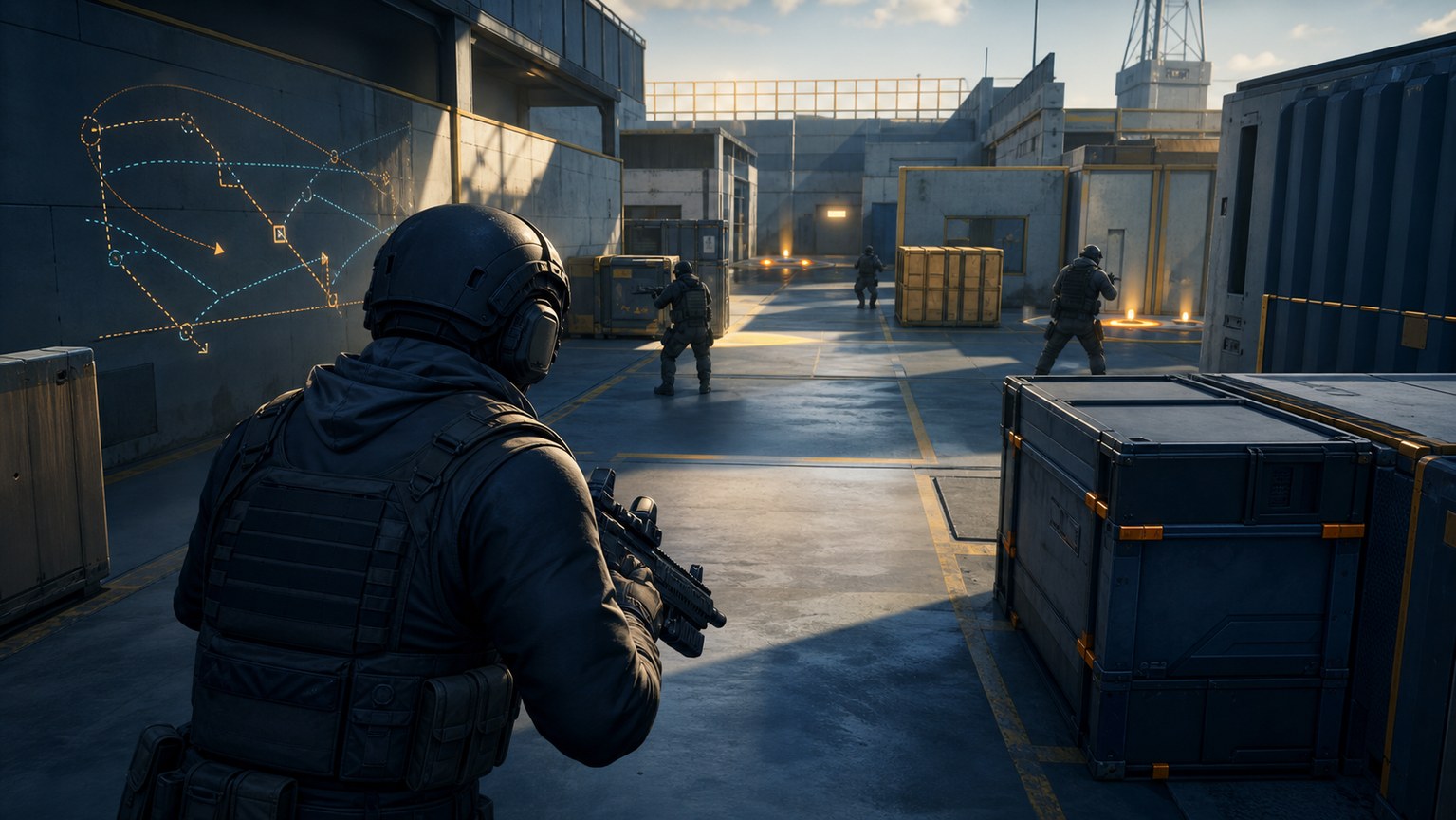
Last reviewed: July 25, 2026. Counter-Strike 2 changes through live updates, so this guide separates durable fundamentals from details that may move with a future patch.
Your first Counter-Strike 2 match may feel unfair. You walk around a corner and die before you can react. A teammate says “save,” another says “rotate,” and the buy menu closes while you are still comparing rifles. That experience is normal. CS2 is not difficult because new players are unwelcome; it is difficult because one short round combines shooting, movement, money, sound, map knowledge, time, and teamwork.
This CS2 beginner guide explains that whole system from the ground up. You will learn which game mode to start with, how a standard bomb round works, when to buy or save, which weapons are forgiving, why stopping before shooting matters, and what to practice during your first ten hours. You do not need perfect aim or a library of grenade lineups to begin. You need a simple mental model and a few habits that keep you useful while your mechanics catch up.
The fastest beginner route
Training Day or bots → 10–15 minutes of Deathmatch → Casual → Retakes → Competitive on one or two maps → Premier after you understand buying and several maps. Do not rush directly into the most serious queue. Each step teaches one layer without asking you to solve everything at once.
This is the first guide in Spack Night’s new Counter-Strike 2 column, where we will build a practical learning path around economy, weapons, aim, movement, maps, utility, settings, Premier, and the updates that materially change how CS2 plays.
What Is Counter-Strike 2?
If you are coming from Global Offensive, our CS2 vs CS:GO comparison explains the ten engine, smoke, tick, map, audio, match, ranking, and buying changes that matter most.
Counter-Strike 2 is Valve’s free-to-play, round-based tactical shooter and the Source 2 successor to Counter-Strike: Global Offensive. Its defining mode is a five-versus-five bomb scenario: Terrorists try to plant and protect the C4, while Counter-Terrorists try to prevent the plant or defuse the bomb. Death is usually permanent until the next round, and equipment is purchased with money earned across rounds.
That last sentence explains why CS2 feels different from a conventional action shooter. A bad decision does not only cost your current life. It may drop an expensive rifle for the enemy, weaken your team’s next purchase, and force everyone to play the following round with inferior equipment. A good player therefore does more than win aim duels. They make decisions that give all five teammates a better chance to win.
Valve’s official CS2 overview highlights several Source 2 systems you will notice immediately: responsive sub-tick input, rebuilt lighting and maps, and dynamic volumetric smoke that interacts with spaces, bullets, and explosions. Smokes are not just gray walls. A grenade can temporarily clear part of one, gunfire can open a brief sightline, and the shape responds to the environment.
The base game is free. Prime Status is a paid account upgrade that matches Prime players with other Prime players and enables ranked progression and Prime rewards. Valve’s Steam Support page explains the current Prime benefits. You can learn the game without Prime, but players who plan to pursue Competitive Skill Groups or a Premier CS Rating will eventually need it.
CS2 Mode Comparison: Where Should a Beginner Start?
CS2 contains several learning environments. The right first mode is the one that isolates the skill you are trying to build, not necessarily the mode with the largest rank attached to it.
| Mode | Main objective | Respawn | Economy | Best beginner use |
|---|---|---|---|---|
| Training Day / Bots | Learn controls and objectives | Flexible | Simplified | Your first launch |
| Deathmatch | Find fights and score kills | Instant | No round economy | Aim, movement, weapon feel |
| Casual | Bomb or hostage objective | Next round | Simplified | Maps and basic objectives |
| Competitive | Standard 5v5 objective | Next round | Full | Learning selected maps seriously |
| Premier | 5v5 after map pick/ban | Next round | Full | Ranked multi-map competition |
| Wingman | 2v2 on one bombsite | Next round | Full | Trades and clutch decisions |
| Arms Race | Progress through weapons | Instant | None | Broad weapon familiarity |
| Retakes | Defend or retake a planted bomb | Next scenario | Loadout cards | Post-plant teamwork |
Training Day and offline practice
Begin here even if you have played other shooters. Confirm your sensitivity, bind voice and text communication, learn how to buy, plant, defuse, walk, crouch, and inspect the radar. Five quiet minutes spent finding those controls is more useful than discovering them while four teammates wait.
Deathmatch
Deathmatch removes the fear of wasting a life. You respawn quickly, select weapons, and take many fights. Use it as a laboratory rather than a scoreboard: keep your crosshair at likely head height, stop before firing, and practise one rifle for several minutes. Ten focused minutes is enough; an hour of frantic running can reinforce bad habits.
Casual
Casual introduces bombsites, round flow, spectating, and rotations with less pressure. The economy is simplified, armor and defuse kits are provided, team damage is disabled, and players can join or leave. Team sizes are larger than standard Competitive, so Casual is not a perfect simulation. It is still a comfortable place to learn where the bombsites, connectors, and common entrances are.
Competitive and Premier
Competitive lets you select maps before queuing and uses a separate traditional Skill Group for each map. It is the better first serious queue because you can learn one environment at a time. Premier uses the current Active Duty pool, a map pick-and-ban phase, a visible CS Rating, and leaderboards. The map pool changes over time, so learn transferable fundamentals rather than memorizing one current list. Valve describes Premier and CS Rating on the official feature page.
Premier is not a tutorial. It expects basic familiarity with several maps and a willingness to communicate through the pick/ban process. Make it a medium-term goal, not the button you must press on day one.
Wingman, Arms Race, and Retakes
Wingman compresses the tactical game into two-versus-two fights around one site. It creates frequent clutch situations and makes trading obvious: if your teammate fights, be close enough to punish the opponent. Arms Race cycles you through weapon types with instant respawns, which is useful for familiarity but does not teach economy. Valve’s returning Retakes mode creates fast four-versus-three post-plant scenarios and offers loadout cards each round. It is one of the most efficient ways to learn how attackers defend a planted bomb and how CTs retake together.
How a Standard CS2 Round Works
In the standard bomb scenario, five Terrorists attack and five Counter-Terrorists defend. There is no respawn during the round. Players begin with a freeze period for buying and planning, then have roughly 1 minute 55 seconds to play before the pre-plant round timer expires.
- Terrorists win by eliminating all CTs before the bomb is planted, or by planting the C4 and allowing it to explode.
- Counter-Terrorists win by eliminating all Terrorists before a plant, letting the pre-plant timer expire, or defusing a planted C4.
- After the plant, the objective overrides elimination. Killing the last Terrorist does not end the round. The CTs still have to defuse.
A regulation match uses MR12: each half contains up to 12 rounds, the teams switch sides after the first half, and the first team to 13 rounds wins regulation. At 12–12, Premier uses a six-round overtime, with teams changing sides after three rounds; a team wins at 16, while 15–15 is a draw. Other queues and special modes may handle ties differently, so do not assume every playlist copies Premier.
The planted bomb normally detonates after 40 seconds. A defuse takes 10 seconds without a kit and 5 seconds with one. This creates one of the most valuable beginner rules in the game: if there is not enough time to finish the defuse, touching the bomb cannot save the round. You may need to save your weapon instead. Conversely, when time is close, attackers do not always need to peek. Staying alive and delaying the CT can be stronger than hunting a final kill.
Beginner habit: glance at the top of the screen after every kill. Count who is alive, check the round timer, and look at the bomb state. Many apparently difficult decisions become simple once you know whether the situation is 5v3, 2v2, or a planted-bomb 1v1.
The CS2 Economy Without the Headache
For a complete round-by-round system covering Eco, Force Buy, Full Buy, loss bonus, drops, and saving, read our CS2 economy guide.
Each half begins with $800 per player, and money is capped at $16,000. You earn money from winning or losing rounds, planting or defusing, and weapon-specific kill rewards. A loss bonus rises through $1,400, $1,900, $2,400, $2,900, and $3,400 as consecutive losses accumulate. Winning usually reduces the loss-bonus level rather than erasing all context instantly. The scoreboard shows your team’s current loss bonus, so you do not have to calculate everything from memory.
Current Competitive configuration also includes a small shared CT reward for each Terrorist eliminated. Exact prices and rewards can change in balance updates. The durable principle is more important than the spreadsheet: five players buying together are stronger than one rich player and four poor players.
The four buys you need to understand
- Full buy: the team can afford rifles or an AWP, armor, useful grenades, and at least some CT defuse-kit coverage.
- Eco or save: spend almost nothing so the team can make a complete purchase next round.
- Half buy or light buy: invest a controlled amount in pistols, SMGs, armor, or limited utility while preserving enough for the planned next round.
- Force buy: spend most available money even though the team cannot afford complete equipment. A force can be correct when the match situation demands risk, but it is not a default response to every loss.
Suppose four teammates have around $2,000 and intend to save, while you have $4,500. Buying an AK alone feels powerful, but your team will fight five coordinated rifles with one rifle and four weak kits. If you save with them, the next round may produce five rifles, five sets of armor, and enough grenades to execute a plan. That second round is usually the better chance.
Read the team money during freeze time. If you are unsure, ask: “buy or save?” Then match the answer. You do not need to lead the economic strategy to avoid breaking it.
Saving a weapon is not surrender
If you are the last CT alive in a 1v4, the bomb is planted, and the site is impossible to retake, keeping a rifle for the next round may have more value than donating it in a hopeless fight. Move to a safe exit, listen for enemies hunting you, and survive the explosion. Saving is situational, not cowardly. The objective is to maximize the team’s chance of winning the match, not to make every round end with your death.
Weapon Buying and Loadouts
CS2 uses a custom loadout. For a complete comparison of prices and use cases, see our CS2 weapons guide. For each side, you equip one starting pistol, four additional pistols, five mid-tier weapons, and five rifles. Only those choices appear in your buy menu. Configure the loadout before queuing so that the weapon you intend to learn is actually available. Valve’s buy-menu announcement also explains two useful features: you can see teammate equipment on the menu, and an unused item bought during the current round can be refunded.
Do not try to master the entire arsenal at once. Start with a small, dependable kit:
- T side: learn the Glock as your starting pistol, MAC-10 for close-range anti-eco pressure, Galil as a budget rifle, and AK-47 as the core rifle.
- CT side: choose either USP-S or P2000 as your starter, use MP9 at close range, FAMAS as a budget option, and commit to learning either M4A1-S or M4A4 first.
- AWP: extremely powerful and extremely expensive. Learn its movement, scope, and positioning in practice before building your team’s economy around it.
- Desert Eagle: rewarding in expert hands, but not a cheap substitute for a rifle. New players often gain more from armor, a simpler pistol, or saving.
For a serious rifle round, a practical priority is usable primary weapon → armor → essential utility → CT defuse kit where the team needs coverage. The exact order can change with money and plan. Armor matters because it reduces damage and aim punch. Grenades are valuable only if you know why you bought them; carrying $1,400 of utility until death is not better than buying one flash you can use confidently.
The 2026 reload rule you must know
Reloading now spends the magazine
Under the magazine-based reload system introduced by Valve in March 2026, reloading takes a fresh full magazine from your reserves and the discarded magazine, including any ammunition still inside it, is lost. Most weapons carry three reserve magazines, though some carry more or fewer. Do not reflexively reload after firing one bullet. Check safety, remaining rounds, and whether a fight is about to continue.
This single change makes old habits expensive. Twenty bullets in an AK magazine are usually enough for another opponent. Reloading in the open creates noise, locks you into an animation, and now wastes ammunition too. Valve documented the change in Guns, Guides, and Games, which also added official early-round map guides for Competitive.
Shooting Fundamentals: Stop, Place, Then Fire
To build a mouse setup around your own movement rather than copying a number, use our CS2 sensitivity guide for eDPI, wrist aim, arm aim, and a seven-day calibration test.
When you are ready to replace the default mouse feel, use our CS2 pro settings guide to compare DPI, eDPI, sensitivity, polling rate, and resolution.
Before drilling aim, make sure the game responds consistently: our CS2 best settings guide covers FPS, frame time, NVIDIA Reflex, Windows, and safe launch options.
Most rifles become inaccurate while you move. The beginner loop is therefore:
- Move toward a position.
- Place the crosshair where an enemy’s head is likely to appear.
- Stop.
- Fire a controlled shot or burst.
- Move again before the return shot arrives.
Crosshair placement creates more easy kills than heroic flicking. Keep the crosshair at head height and near the edge an enemy is likely to cross. If it points at the floor, every duel begins with a large correction. If it floats far from the corner, a close enemy appears inside the gap before you can react.
Counter-strafing is the technique of briefly tapping the opposite movement key to stop faster: release D and tap A, or release A and tap D. You do not need perfect timing on day one. Begin by making a visible pause before shooting, then reduce that pause as the stop becomes reliable.
Use taps and short bursts at medium or long range. Continuous fire creates a recoil pattern that pulls shots away from the crosshair. Spray control is learnable, but a new player should first understand the opening bullets of one rifle. Crouching can stabilize some fights, yet automatic crouching makes you stationary and may move your head into an experienced opponent’s adjusted aim. Treat crouch as a choice, not a panic button.
Sound, Radar, Utility, and Information
CS2 is an information game disguised as a shooting game. Running, jumping, reloading, dropping weapons, throwing grenades, scoping some weapons, planting, and defusing all create information. Walking lets you move quietly, but it is slower. The correct choice depends on whether speed or concealment matters more.
Check the radar in moments of safety. It shows teammate positions, spotted enemies, deaths, and the bomb. Enlarge or configure it until nearby map structure is readable without losing too much peripheral awareness. A two-second radar glance before rotating can prevent you from abandoning the wrong bombsite.
Keep voice calls short and factual:
- “Two B, bomb seen.”
- “AWP mid.”
- “Flashing over.”
- “One hit, going connector.”
- “Saving.”
Say what you know, not what you fear. “All B!” after hearing one footstep can pull an entire defense out of position. If a player is abusive, mute them and keep playing. Preserving concentration is more useful than winning an argument.
Learn utility by purpose before lineup. A smoke blocks vision and can divide a site. A flashbang creates a timing window, especially when thrown for a teammate. A HE grenade deals damage and can briefly disrupt smoke volume. A Molotov or incendiary clears a position or delays movement. Begin with one safe smoke and one simple flash on each map you play. Ten remembered lineups are useless if you do not understand when the team needs them.
Why Is Counter-Strike 2 So Hard?
CS2 feels harsher than many shooters because several forms of difficulty multiply each other:
- Low time to kill: a well-placed shot can end a fight immediately, leaving little time to correct bad positioning.
- One life per round: mistakes create downtime and deny you another attempt until the next round.
- Movement accuracy: the instinct to strafe while shooting, useful in other games, often makes rifle fire unreliable here.
- Persistent economy: the cost of a death or dropped weapon can affect several later rounds.
- Map geometry and timing: common angles, routes, wall materials, spawn timings, and rotations shape every duel.
- Team dependence: even brilliant aim cannot watch five routes. Trading, utility, spacing, and information connect individual actions.
- Experienced population: many opponents have years of Counter-Strike habits that transfer directly into CS2.
The solution is not to learn everything simultaneously. Separate the stack. Deathmatch teaches stopping and shooting. Casual teaches sites and objectives. Retakes teach post-plant decisions. Competitive teaches full economy and team rhythm. Review one mistake after a match instead of judging the match only by kills.
Your First 10 Hours: A Practical CS2 Learning Plan
Hours 0–1: controls and one rifle per side
Complete Training Day or play offline with bots. Set a comfortable sensitivity, enable clear audio, bind push-to-talk, and find the bomb, buy, drop, walk, crouch, use, and grenade controls. Choose AK-47 for T and one M4 for CT. Practise stopping before firing at a wall and observe where bullets travel.
Hours 1–3: focused Deathmatch
Play short sessions. Spend five minutes with the AK, five with your M4, and a few minutes with an SMG. Ignore placement. Your goals are head-height crosshair position, deliberate stops, and calm two-to-four-shot bursts. End the session when concentration becomes sloppy.
Hours 3–5: Casual on one map
Choose a common bomb map and learn both sites, T and CT spawns, the main routes between sites, and three or four useful location names. Follow teammates without standing directly behind them. Watch after death: note where experienced players hold their crosshair and when they rotate.
Hours 5–7: Retakes, Wingman, or more Casual
Use Retakes to understand post-plant positions and defuse pressure. Use Wingman if you want more two-player trades and clutch repetitions. Learn one smoke, one flash, and one fire grenade use on your chosen map. The goal is not a lineup collection; it is being able to help the next real round.
Hours 7–10: first Competitive matches
Queue only the map or two you studied. At the start, tell teammates you are learning and will make concise calls. Buy with the team, avoid taking the bomb on unexplained solo adventures, and play close enough to trade. Afterward, choose one recurring issue: crosshair too low, moving while firing, reloading in danger, rotating too early, or buying alone. Make that the next session’s theme.
First-Match Checklist
- Is my microphone bound, and can I hear footsteps clearly?
- Do I know whether the team is buying, saving, or forcing?
- If I carry the bomb, do I know where it is and whether I can safely drop it to a teammate?
- Am I close enough to trade a teammate without blocking their retreat?
- Is my crosshair at head height before I reach the corner?
- Did I stop before firing?
- After a kill, do I know the player count, timer, and bomb state?
- Am I reloading because I need to, or because the animation feels reassuring?
Common Beginner Mistakes
Buying every round. A weak purchase can delay a strong team round. Save together when the team saves.
Walking everywhere. Silence is valuable, but arriving ten seconds late can lose the objective. Run when opponents already know your position or when time matters more than secrecy.
Standing too close behind a teammate. You block their retreat and may both die to one spray. Maintain enough spacing to trade without becoming one target.
Peeking after the bomb is planted. Attackers often win by hiding, creating crossfires, and forcing CTs to spend time. You do not need another kill if the timer is winning for you.
Reloading after every fight. The discarded magazine now loses its remaining ammunition. Reload only from real safety and with a reason.
Copying professional settings blindly. A pro’s resolution, sensitivity, and crosshair solve that player’s needs. Use them as references, then choose settings you can read and control consistently.
CS2 Beginner FAQ
Is Counter-Strike 2 free?
Yes. The base game is free on Steam. Prime Status is a paid upgrade tied to Prime matchmaking, ranked progression, XP, and Prime rewards. Learn the mechanics first, then decide whether the ranked ecosystem is worth the upgrade for you.
Should a beginner start with Competitive or Premier?
Start with Competitive after Training, Deathmatch, and Casual. Competitive lets you select one or two maps and learn them deeply. Premier expects several-map knowledge, includes pick/ban, and centers progression on CS Rating. Move there when standard buying, callouts, and the active map pool no longer feel mysterious.
What is the best CS2 weapon for a beginner?
There is no universal beginner gun, but a useful core is AK-47 on T, M4A1-S or M4A4 on CT, MAC-10 and MP9 for close-range low-cost rounds, and Galil or FAMAS when a full rifle is unaffordable. Avoid changing your primary weapon every match; familiarity accelerates learning.
Should I buy armor or a better gun?
In serious rifle rounds you usually want both. If money forces a compromise, consider the team’s plan, expected opponent weapons, and whether you already have equipment. Armor limits damage and aim punch; a powerful rifle does not help if being hit makes your return fire uncontrollable. Match the team buy rather than applying one rule mechanically.
What does “eco” mean?
An eco is a low-spending round designed to preserve money for a stronger later purchase. It is not permission to stop trying. Stack a site, set a close-range trap, recover a dropped weapon, or protect exits while keeping the planned budget intact.
What is a trade?
A trade happens when an opponent kills your teammate and you quickly kill that opponent before they can escape or reset. Good spacing keeps you close enough to trade but far enough that one burst or grenade does not kill both players.
How long should I practise aim?
Ten to twenty focused minutes before serious matches is enough for most beginners. Define one goal, such as stopping before every rifle burst. Long, unfocused sessions can train rushing, panic spraying, and scoreboard chasing instead of match-ready technique.
Do I need to memorize grenade lineups?
No. First learn what each grenade accomplishes and one dependable use per map. Add lineups when you repeatedly encounter a problem that a specific smoke or flash solves. Understanding a grenade’s purpose makes the lineup memorable.
Why do my bullets miss when the crosshair is on the enemy?
The most common causes are movement inaccuracy, recoil after the first bullets, being flashed or aim-punched, or firing before your weapon has recovered. Record or review the moment if possible. Start by making your stop obvious, firing a short burst, and waiting for accuracy to reset.
How do I deal with toxic teammates?
Give concise information, avoid debating mistakes mid-round, and mute abuse. Report serious misconduct through the available game tools. You are responsible for learning and cooperating, not for absorbing harassment.
The One Rule to Remember
A strong CS2 beginner does not need to top the scoreboard. Be the player who buys with the team, communicates what they actually know, carries useful equipment, trades nearby teammates, and learns one lesson from each match. Aim improves through repetition. Map knowledge grows one route at a time. Economic judgment becomes natural after enough freeze periods.
Counter-Strike 2 is hard because every small action matters. That is also why improvement feels so satisfying: the first clean counter-strafe, the first correct save, the first flash that wins a site, and the first calm defuse are visible proof that you understand more than you did yesterday.
Official Sources and Further Reading
- Valve: Counter-Strike 2 features, Premier, smoke, and sub-tick overview
- Steam: Counter-Strike 2 store page
- Steam Support: Prime Status and free-to-play accounts
- Steam Support: Profile Rank, Competitive Skill Groups, and CS Rating
- Valve: MR12 and CS Rating announcement
- Valve: CS2 loadout, buy menu, teammate equipment, and refunds
- Valve: March 2026 magazine-based reload system and map guides
- Valve: Retakes mode
- Valve: loss-bonus system
- SteamDatabase GameTracking: current Competitive configuration mirror
- Liquipedia: defuse-kit timing and price reference
Editorial note: core claims are based primarily on Valve and Steam documentation. Where Valve does not publish a single current rules page, live configuration tracking and established competitive references are used for exact timing. Spack Night will revisit this guide when a major rules or economy update changes beginner advice.
6 thoughts on “CS2 Beginner Guide: Everything You Need Before Your First Match”