Last reviewed: July 26, 2026. Counter-Strike 2 is a live game, so individual maps, modes, ranking rules, and performance can change after publication. The engine-level differences in this guide are based primarily on Valve’s official CS2 materials and release notes.
Counter-Strike 2 looks familiar because the fundamentals were deliberately preserved. You still play five-versus-five bomb defusal, control recoil, manage money, trade teammates, learn utility, and lose rounds because somebody peeked alone with the bomb. But underneath that familiar structure, CS2 changes how the server records actions, how smoke behaves, how maps are rendered, how matches are structured, and how players buy and rank.
This CS2 vs CS:GO guide explains the ten changes that matter most to a new or returning player. It separates visible upgrades from gameplay consequences, and it also explains what did notcomplete CS2 beginner guide, then use the comparison below to understand why older CS:GO advice sometimes feels almost right but not completely right.
The short answer
CS2 is not a different genre and it is not merely a graphics patch. It keeps Counter-Strike’s core gunplay and economy while moving the game to Source 2, adding responsive volumetric smoke, sub-tick input timing, brighter rebuilt maps, modern effects and audio, shorter MR12 matches, Premier rating, and a redesigned loadout and buying system.
CS2 vs CS:GO: The 10 Biggest Differences at a Glance
| Change | CS:GO | CS2 | Practical effect |
|---|---|---|---|
| 1. Engine | Source engine lineage | Source 2 foundation | Modern lighting, materials, tools, effects, and a new platform for updates |
| 2. Smoke | Mostly fixed visual volume | Dynamic volumetric object | Bullets and HE grenades can briefly open sightlines |
| 3. Server timing | Actions evaluated around discrete ticks | Sub-tick event timing | The server records when movement, shots, and throws occur between updates |
| 4. Maps | Older lighting and material pipeline | Touchstone, Upgrade, and Full Overhaul approaches | Some layouts stay familiar while visibility and lineups can feel different |
| 5. Visual feedback | Legacy particles and HUD | Rebuilt particles, tracers, impacts, fire, water, and UI | More information is communicated visually, but there is more screen activity |
| 6. Audio | Familiar legacy mix | Reworked environmental and game-state audio | Old sound-distance instincts need recalibration |
| 7. Match length | Classic competitive MR15 | MR12, 24-round regulation maximum | Pistol rounds and economy mistakes carry more weight |
| 8. Ranked identity | Skill Groups were the main language | Premier adds visible CS Rating and leaderboards | Progress is more numerical and map voting matters |
| 9. Buying | Radial buy wheel and broad weapon access | Custom loadout, grid menu, teammate equipment, refunds | Preparation before queueing now affects in-match options |
| 10. Content pipeline | Older tools and assets | Source 2 Workshop tools and upgraded item presentation | Community maps and cosmetics have a more modern production base |
1. Source 2 Is the Foundation, Not Just a Graphics Setting
For a measured Source 2 performance setup, use our CS2 best settings guide to tune video options, NVIDIA Reflex, Windows, and frame caps.
The largest difference between CS2 and CS:GO is the move to Valve’s Source 2 engine. An engine governs much more than how shiny a floor looks. It affects rendering, lighting, particles, asset creation, map tools, animation, audio behavior, networking support, and how developers can build future features.
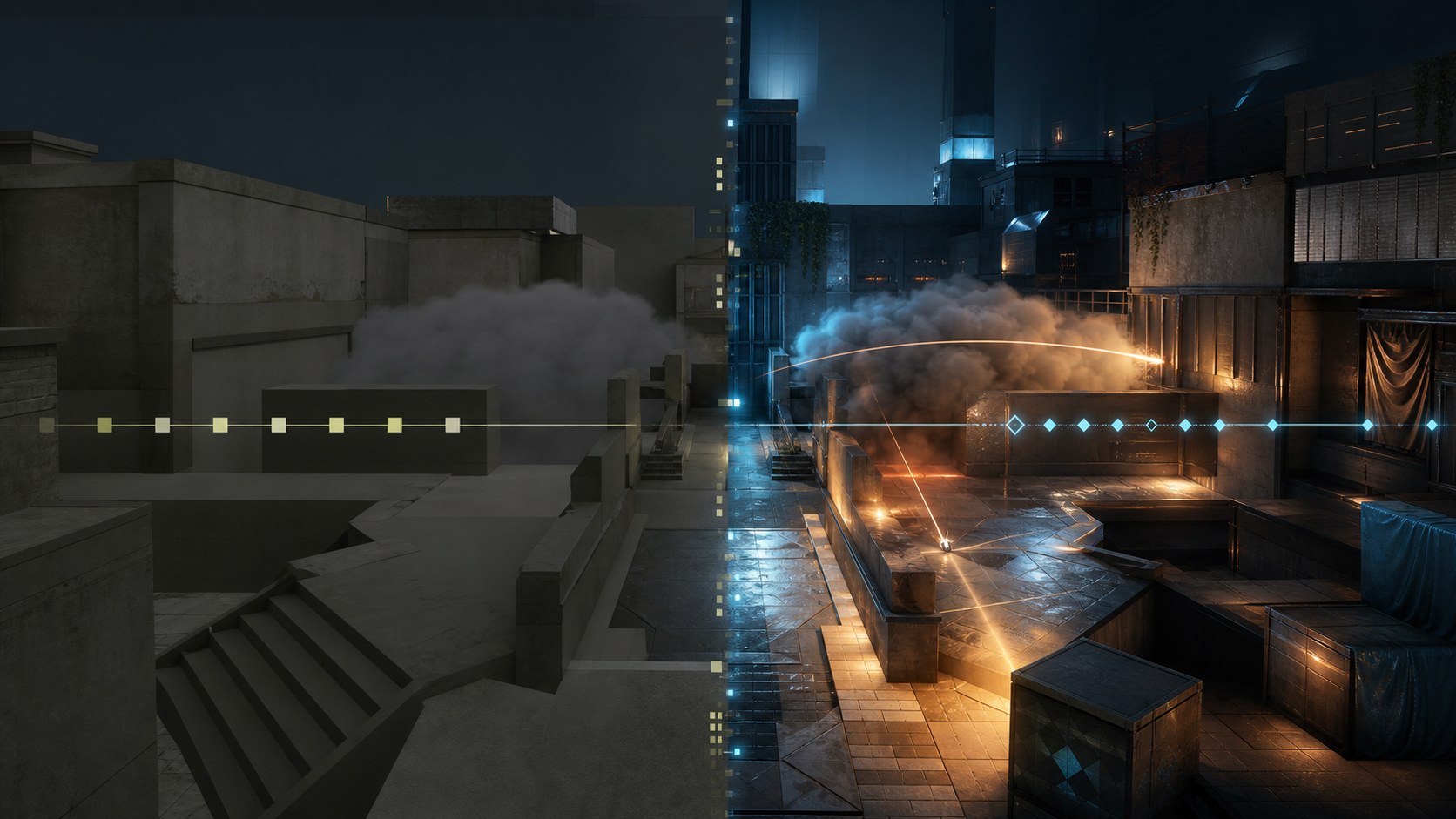
Valve described CS2 as the largest technical leap in Counter-Strike history. That description makes sense when you look beyond screenshots. Source 2 enables physically based rendering, richer materials and reflections, modern particle systems, higher-resolution weapon models, and updated creation tools for community artists. Valve’s official CS2 overview groups these changes into maps, smoke, tick architecture, effects, items, UI, and audio rather than treating the engine as a single graphics toggle.
For a new player, the practical lesson is simple: do not expect CS:GO performance settings to transfer one-for-one. CS2 asks more from modern hardware, and a beautiful preset is not necessarily the best competitive preset. Stable frame time, clear shadows, low input delay, and readable enemies matter more than maximizing every effect. Start with a stable frame rate, then increase visual quality selectively.
Source 2 also does not mean every old skill disappeared. Crosshair placement, recoil discipline, trading, positioning, utility timing, and economic coordination remain central. The engine changed; the competitive grammar survived.
2. Smoke Grenades Became Responsive Volumetric Objects
Smoke is the most immediately understandable gameplay change. In CS:GO, smoke behaved largely like a fixed visual obstacle after it bloomed. In CS2, smoke is a three-dimensional volumetric object that fills available space, interacts with lighting, and reacts to the environment.
Valve’s official presentation calls these responsive smokes. They expand naturally through openings and around objects instead of simply displaying the same independent cloud everywhere. More importantly, every player sees the same smoke shape, which is essential in a competitive game.
Bullets and HE grenades can change the smoke
Firing through a smoke creates a temporary opening along the bullet path. A high-explosive grenade can disperse a larger section of the volume for a short period. This creates new decisions that did not exist in the same form in CS:GO:
- Information: firing through smoke may reveal a narrow line of sight, but your tracers and position can also become easier to read.
- Execution: a team can use an HE grenade to temporarily expose a defender behind a common smoke.
- Defense: a smoke is not an invulnerable wall. You must be ready for a temporary gap.
- Timing: the opening closes, so teammates must coordinate their peek with the grenade or bullet interaction.
The 2023 Limited Test notes repeatedly adjusted smoke expansion, lighting, shotgun-created holes, and HE interaction. That matters because it shows the system is gameplay simulation, not merely an animated texture. Valve documented these changes in its June 2023 CS2 update notes.
Beginner rule: do not stand in the center of a smoke assuming nobody can see you. Use its edge, move unpredictably, and understand that an HE grenade may turn your cover into a window.
3. CS2 Uses Sub-Tick Event Timing
This is the most discussed and most misunderstood difference. CS:GO servers evaluated the game world at discrete intervals called ticks. Matchmaking servers and third-party servers could feel different partly because their update rates differed. CS2 introduced what Valve calls a sub-tick update architecture.
According to Valve, the server can know the precise moment between ticks when a player starts moving, fires a shot, or throws a grenade. In other words, the event carries timing information rather than being understood only by the next coarse update boundary.
Important correction: CS2 is not magically “tickless,” and sub-tick does not remove ping, packet loss, frame-time problems, interpolation, server load, or every form of perceived inconsistency. It changes how important input events are timed and processed. Your connection and local performance still matter.
For new players, the useful consequence is not a networking debate. It is consistency: movement releases, shots, and grenade throws are designed to preserve their timing more precisely. Valve continued tuning the presentation of sub-tick actions after launch; a November 2023 update made visual and audio feedback from sub-tick input render on the next frame and synchronized shooting-spread data so tracers and decals better matched server-authoritative trajectories.
This also means some very old CS:GO configuration folklore is irrelevant or actively misleading. Do not paste a decade-old list of networking commands into your console. Use the current game settings, maintain a stable frame rate, choose a sensible nearby server region, and judge problems with repeatable tests rather than one dramatic death animation.
4. Maps Are Cleaner, Brighter, and Rebuilt at Different Levels
CS2 did not convert every map in exactly the same way. Valve originally explained three approaches:
- Touchstone maps: established layouts preserved so players could evaluate gameplay changes, with improved lighting and character readability.
- Upgrade maps: familiar maps using Source 2 lighting, physically based materials, reflections, and rendering improvements.
- Full Overhaul maps: environments rebuilt from the ground up using the new tools and rendering features.
This distinction explains why one CS2 map may feel almost identical to its CS:GO version while another feels substantially more open, bright, or detailed. A returning player should not assume that every lineup, shadow, background landmark, or piece of cover translates perfectly.
Brighter does not mean simpler
Improved character readability is a competitive goal, but modern materials and lighting also add information. Reflections, brighter surfaces, deeper environmental detail, and new shadow behavior can change what catches your eye. A position that felt visually quiet in CS:GO may feel busier in CS2.
Learn maps through geometry first: entrances, elevation, cover, rotation time, plant positions, and common defender angles. Then relearn exact utility lineups in CS2. A grenade tutorial recorded in CS:GO may explain the correct strategic idea while giving you an obsolete visual reference or landing point.
5. Visual Effects Communicate More Game State
Source 2 changed water, explosions, fire, smoke, muzzle flashes, bullet tracers, impact effects, and the HUD. Valve says these effects were redesigned for both fidelity and readability. The most useful word is information.
Bullet impacts are easier to identify at range. Tracers help reveal where fire is coming from, although they should not be treated as a perfect substitute for understanding recoil. Molotov and incendiary fire is more volumetric and visually connected to the surface it occupies. The C4, kill feedback, HUD effects, and round-state presentation are more animated.
The danger for beginners is watching the spectacle instead of reading the fight. Use visual feedback to answer specific questions:
- Where did the shot come from?
- Did the grenade open a smoke?
- Which area is actually covered by fire?
- Did my bullet impact show that my spray moved above the target?
- Did the bomb change the urgency of the round?
If visual effects make targets harder to track on your hardware, lower expensive settings until your frame time is stable. Competitive clarity is an outcome, not a particular graphics preset.
6. Audio Was Reworked Around Environment and Information
CS:GO veterans built strong instincts around the exact distance and texture of footsteps, weapon reports, reloads, bomb actions, and utility. CS2 reworked and rebalanced audio to reflect the physical environment, make sounds more distinct, and communicate more game state.
That includes environmental reverberation and occlusion: a sound in an open area should not present exactly like the same sound behind walls or inside a tunnel. Valve has adjusted the mix many times because competitive audio must balance realism with dependable information.
New players should develop three habits:
- Protect the signal. Keep music and unnecessary voice volume low enough that footsteps, reloads, scope sounds, plants, and defuses remain clear.
- Use headphones correctly. Stable stereo positioning is more valuable than aggressive virtual-surround processing that smears direction.
- Do not over-call. Sound gives a likely position and action, not perfect wall vision. Communicate the sound and location without inventing certainty.
A returning player needs time to rebuild distance judgment. The category of information is familiar, but the mix and environmental treatment are not identical.
7. Competitive Matches Moved from MR15 to MR12
Classic CS:GO competitive play was associated with MR15: up to 15 rounds per side in regulation, with the first team to 16 winning. CS2 moved Premier, Competitive, and Major play to MR12: a maximum of 24 regulation rounds, with the first team to 13 taking the match before overtime.
Valve explained the change in its Your Time Is Now announcement, noting that economy and balance changes had reduced the need for longer matches. Premier and Competitive use six-round overtime when regulation ends level under the applicable rules.
Why four fewer regulation rounds matter
A shorter half compresses the economy. Losing the pistol round, converting the next round badly, and breaking your money later consumes a larger percentage of the available half. There is less time to recover from three isolated Force Buys or a missed anti-eco.
| Situation | MR15 mindset | MR12 lesson |
|---|---|---|
| Pistol loss | More rounds remained for recovery | The second-round plan must be coordinated immediately |
| Broken buy | Sometimes absorbed over a longer half | One scattered purchase can damage a large part of the half |
| Save decision | Future value was important | Future value remains important, but fewer rounds can increase urgency |
| Momentum | More time to diagnose an opponent | Adaptations must happen earlier |
Our CS2 economy guide explains exactly when to Eco, Force Buy, Full Buy, or Save under the current system.
8. Premier and CS Rating Changed the Ranked Conversation
CS:GO players commonly described their level through named Skill Groups. CS2 still has Competitive matchmaking, but Premier became the central ranked destination. It uses an Active Duty map pick-ban phase and gives players a visible numerical CS Rating.
Valve introduced CS Rating as a measurement used for global and regional leaderboards. That changes how progression feels: a number shows smaller movement than a broad badge, seasonal play can recalibrate ratings, and map vetoes become part of the match before the first pistol is fired.
For a new player, Premier is not automatically the best first classroom. Casual, Deathmatch, practice, and ordinary Competitive games can help you learn controls and maps with less rating anxiety. Enter Premier when you can:
- communicate basic information without flooding voice chat;
- recognize the main routes and bombsites on the active maps;
- buy with your team;
- throw at least one useful smoke or flash on each comfortable map;
- accept that map selection is a team decision.
Your rating is a matchmaking signal, not a complete description of your value. A good teammate who trades, carries utility, drops weapons, and communicates clearly can create wins that are invisible in a simple kill count.
9. The Buy Wheel Became a Custom Loadout and Grid
CS:GO’s circular buy wheel gave way to a single-screen grid. CS2 also introduced customizable weapon loadouts for each side. Players choose a starting pistol slot, four additional pistol slots, five mid-tier slots, and five rifle slots. A weapon left outside the loadout cannot be purchased during the match.
This creates a preparation step that new players often overlook. Before queueing, make sure your loadout includes the weapons you genuinely intend to learn. Do not copy a professional player’s loadout without understanding why each slot exists.
Three quality-of-life improvements matter immediately
- Refunds: an unused purchase made during the current buy period can be sold back. A mistaken click no longer has to ruin the round.
- Teammate equipment: the buy screen shows what teammates are carrying, helping the team identify missing rifles, kits, or utility.
- Both M4 choices: the CT rifle loadout can include both the M4A4 and M4A1-S if you dedicate slots to them.
Refunds are not permission to buy thoughtlessly. Once an item is used, thrown, or otherwise no longer eligible, the correction window closes. The best routine is still: look at team money, agree on the round type, then purchase armor, weapon, utility, and kit in that order of strategic need.
Use our complete CS2 weapons guide to compare the firearms, prices, kill rewards, and best use cases before finalizing your loadout.
10. Inventories Continued, but the Creation Pipeline Changed
CS2 replaced CS:GO as the active Counter-Strike platform without discarding player inventories. Valve carried existing CS:GO items into CS2 and applied Source 2 lighting and materials to them. Stock weapons received higher-resolution models, while legacy models and finishes remained supported.
The important competitive point is that skins remain cosmetic. A finish does not improve recoil, damage, movement speed, or accuracy. Different presentation can affect personal perception, but the weapon statistics do not become stronger because the finish is expensive.
For creators, Source 2 Workshop tools provide the modern pipeline for maps, stickers, and weapon finishes. Valve’s June 2023 notes also described GPU-accelerated ray tracing in Hammer for previewing and baking lighting. That does not change your first matchmaking round, but it matters for the game’s future: community creators can build on the same modern platform rather than an increasingly old toolchain.
What Did Not Change from CS:GO?
The fastest way to misunderstand CS2 is to focus only on novelty. The following principles remain recognizably Counter-Strike:
- Movement affects accuracy. Stop or counter-strafe before taking precise rifle shots.
- Recoil must be controlled. Long sprays climb and spread; disciplined bursts are easier for beginners.
- Head placement wins fights. Crosshair placement often matters more than raw flick speed.
- Information is a resource. Sound, radar, utility, deaths, timing, and teammate calls build a picture of the round.
- Economy is shared strategy. Five synchronized average weapons are usually better than one luxury rifle and four broken buys.
- Trading matters. A teammate’s death should create an immediate opportunity to eliminate the opponent who fired.
- Utility creates safe advantages. Smokes, flashes, HE grenades, and fire are not decorations.
- Map knowledge compounds. Routes, angles, timings, rotations, and grenade lineups improve every other skill.
Old CS:GO educational content can therefore remain useful when it teaches concepts. Be cautious when it teaches exact smoke lineups, graphics commands, networking commands, matchmaking structure, buy-menu behavior, or map-specific geometry.
Which Old CS:GO Habits Should You Unlearn?
| Old habit | Why it fails | CS2 replacement |
|---|---|---|
| Treat smoke as a sealed wall | Bullets and HE grenades can create temporary openings | Play smoke edges and anticipate interaction |
| Copy old grenade pixels blindly | Lighting, geometry, and visual references may differ | Verify every lineup in a CS2 practice server |
| Assume there is time to recover later | MR12 has fewer regulation rounds | Make economy and adaptation decisions earlier |
| Expect every gun in the buy menu | CS2 uses a selected loadout | Configure T and CT slots before queueing |
| Paste legacy networking commands | CS2 uses a different architecture and removed legacy controls | Use current settings and troubleshoot with measured evidence |
| Judge distance with CS:GO audio memory | The mix and environmental treatment changed | Relearn cues through focused matches and practice |
Is CS2 Harder Than CS:GO?
For a completely new player, both games share the same intimidating core: fast lethality, punishing movement accuracy, recoil, an economy, many maps, and opponents with years of experience. CS2 improves onboarding in some areas through Training Day, clearer presentation, teammate equipment information, and refunds. At the same time, responsive smoke and a denser visual environment add new information to process.
For a CS:GO veteran, CS2 can initially feel harder because tiny learned timings no longer produce identical sensory feedback. The player may know what should happen but see a different animation, hear a different distance, or encounter a smoke interaction that did not exist before. That gap is adaptation, not proof that every old skill is gone.
The best learning order is:
- stabilize performance and basic settings;
- learn stopping, shooting, and recoil;
- understand round rules and money;
- become comfortable on two or three maps;
- learn a small utility toolkit;
- add Premier and broader map knowledge later.
FAQ: CS2 vs CS:GO
Is CS2 a separate game from CS:GO?
CS2 is the current Counter-Strike game and replaced CS:GO as the active product on Steam. It preserves the series’ competitive design and player inventories while moving the platform to Source 2.
Is CS2 free?
Yes. Valve launched Counter-Strike 2 as free to play. Prime Status is a separate account upgrade associated with Prime matchmaking eligibility and related benefits.
Did CS2 change the recoil patterns?
The fundamental recoil-control skill remains. Do not assume every sensation or animation is identical to CS:GO, but the correct beginner response is still to stop before accurate rifle fire, learn short bursts first, and practice the main rifle patterns. See the weapons guide for individual recommendations.
Is sub-tick better than 128 tick?
That question oversimplifies two different approaches. Valve designed sub-tick event timing so the server knows when important actions occur between updates. A complete experience still depends on server performance, frame time, latency, packet delivery, interpolation, and implementation. “Sub-tick” should not be used as a promise that all networking imperfections disappear.
Can I use CS:GO smoke lineups in CS2?
Some concepts and even some lineups transfer, especially on preserved map geometry, but never assume. Map rendering, sky behavior, collision, landmarks, and grenade interaction can differ. Verify the lineup in CS2 before using it in a match.
Why did CS2 shorten matches?
Valve said previous economy and balance changes had reduced uncontested rounds and allowed exciting matches to be resolved with fewer rounds. CS2 therefore adopted 12-round halves for Premier, Competitive, and Major play.
Did my CS:GO skins disappear?
No. Valve carried CS:GO inventories into CS2. Items benefit from Source 2 lighting and materials, while some finishes can use updated high-resolution weapon models.
Final Verdict: Familiar Rules on a New Technical Platform
The central conclusion of this CS2 vs CS:GO comparison is that Valve changed the platform more aggressively than the game identity. Source 2, responsive smoke, sub-tick event timing, rebuilt visuals, environmental audio, MR12, Premier rating, and modern buying all matter. Yet the player who communicates, controls movement, understands money, trades teammates, and learns maps still wins for familiar reasons.
If you are new, do not study CS:GO first to “prepare” for CS2. Learn the current game directly. Use old material only when it teaches enduring fundamentals, and verify every exact setting, lineup, map detail, and economy claim against CS2. Continue through the Spack Night Counter-Strike 2 column for beginner lessons, weapons, economy, and future map and utility guides.
Official Sources and Update Policy
- Valve: Introducing Counter-Strike 2 — official explanations of Source 2 maps, responsive smoke, sub-tick architecture, items, VFX, UI, and audio.
- Valve: June 2023 Limited Test updates — loadouts, the grid buy menu, refunds, Workshop tools, smoke interaction, sub-tick tuning, and sound changes.
- Valve: Your Time Is Now — CS Rating, Premier leaderboards, and the move to 24-round regulation.
- Valve: Welcome Home and launch notes — CS2 launch, Training Day, matchmaking modes, smoke, sound, and gameplay fixes.
- Valve: November 2023 update notes — sub-tick visual/audio feedback and synchronized shooting-spread presentation.
Spack Night uses official Valve announcements for engine and rules claims. Because CS2 is continuously updated, readers should check the official Counter-Strike update log when a current patch could affect a specific map, mode, or mechanic.
One thought on “CS2 vs CS:GO: 10 Differences Every New Player Should Know”